



Jib Crane
Jib Crane

Jib Crane
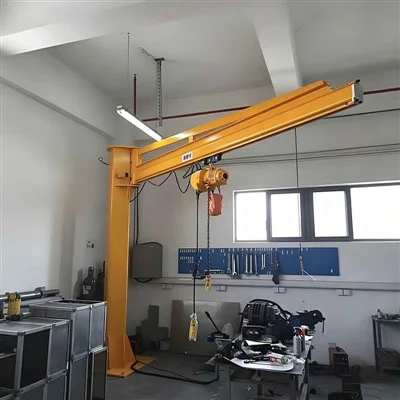
Jib crane is a practical lifting equipment. It has a relatively simple structure, low cost, and flexible operation, making it particularly suitable for frequent lifting of small and medium-sized cargo around fixed workstations or in situations that require certain mobility. Column and wall mounted models meet diverse spatial and operational needs and are essential tools for industrial production.
Kinocrane brand jib crane has compact structure, it is easy to install in narrow working space; it also has wide rotating angle to rotate from 90-360 degree freely, the special designed rolled bearing to achieve smooth travel with low noise.
Wide Rotating Angle
Free to rotate from 90-360 degree, special designed rolled bearing to achieve smooth travel with low noise.
Three Structural Forms
The type of jib crane are Wall Mounted Jib Crane and Floor Mounted Jib Crane or pillar jib crane.
Advantages
Simple structure, low cost, flexible operation, space saving, relatively easy installation, easy to use and maintain, strong adaptability.
Lifting Capacity
The maximum lifting capacity can reach up to 10 tons.Very suitable for workshops, repair stations and assembly lines.
Kinocranes Jib Crane
Kinocranes Jib crane is a new generation of light hoisting equipment made for modern production, which is suitable for high-reliability electric chain hoists.Kinocranes Jib crane is especially suitable for short distances, frequent use and intensive lifting operations. The advantage of jib crane is efficient, energy-saving,Small footprint, easy to operate and maintain.Kinocranes provides tailored proposal to realize the features as high work efficiency, cost saving and safety.
Jib Crane Types
The choice of which type to use mainly depends on factors such as the scope of work, lifting capacity, space limitations, and whether mobility is required.


Electric hoist suitable for Jib Crane
Choose the appropriate matching hoist, and make it easier for you to lift the goods.


Products



Jib Crane FAQ Content
CATEGORY 1: Selection & Technology
Q: What is a jib crane, and what are its main types?
A: Jib cranes are widely used lifting tools. They have a horizontal boom mounted on a vertical mast or wall bracket. The boom rotates freely, while the hoist and trolley run along the beam to serve circular work zones. Easy to install with just one fixing point and no overhead tracks required, they work perfectly for on-site spot lifting.
Main types are listed below:
- Wall-mounted Jib Crane:Fixed to building columns, no floor occupation. Rotation: up to 200°, capacity: 250 kg to 5 tons.
- Freestanding Jib Crane:Stand-alone mast set on concrete foundation, full 360° rotation. Capacity ranges from 0.5 to 10 tons.
- Wall Traveling Jib Crane:Runs on wall/column rails. The entire boom slides horizontally for flexible lifting and precise load positioning.
- Articulating Jib Crane:Two-section boom enables smooth operation around pillars and other site obstacles.
- Portable Jib Crane:Mobile base for light loads, convenient to move from one workstation to another.
Q: What is the difference between a wall-mounted jib crane and a floor-mounted jib crane?
A: The wall-mounted jib cranes are directly installed on the wall or the side of the column through brackets, equipped with a rotatable boom and a lifting hoist that runs along the arm. They are used to vertically lift heavy objects and perform limited-range horizontal movement in the area close to the wall, without occupying the ground space. The rated lifting capacity is generally from 125 kg to 5 tons, with a boom length of 1–6 meters. The working range is mostly a 180°–220° fan-shaped area. Installation does not require anchor bolts or concrete foundations, but the strength of the supporting structure is very high.
The floor-mounted jib crane is a type of lightweight lifting equipment installed on a concrete foundation on the ground. It consists of columns, rotating arm and lifting pulley. It does not rely on the wall and can achieve 360° rotation and horizontal movement within the arm track. Its typical carrying capacity ranges from 0.125t to 10t, and the arm length is 1 to 6 meters. The columns are fixed to the ground via anchor bolts, thus requiring a high level of stability for the foundation.
The jib crane is equipped with a column or wall-mounted structure, and is combined with an electric hoist to achieve three-dimensional transportation. The floor-standing type provides stronger load-bearing capacity and 360° full-directional operation capabilities thanks to its stable foundation. The wall-mounted type, with its zero-occupancy advantage, is suitable for scenarios with limited space. When selecting, the primary assessment basis should be the rated load, rotation range, and installation structure's load-bearing capacity.
Q: How do I determine the right jib crane size and capacity for my application?
A: Four key parameters define the specification:
1. Lifting capacity — the heaviest load plus all rigging (hoist block, slings, shackles), with a 15–20% margin above the maximum working load.
2. Boom reach — horizontal distance from mast center to the farthest pick-up or set-down point. Add approximately 0.5 m margin so the trolley does not operate at the extreme boom tip.
3. Lifting height — Distance from the ground to the highest hook position, minus the head space occupied by the hoist and trolley. Note that the values will vary depending on the type of electric hoist used.
4.Duty cycle — how often the crane lifts per hour. High-frequency production use requires a heavier duty classification than occasional maintenance lifting.
The working environment also affects the selection of materials and components. At the beginning of the specification selection process, it is necessary to clearly determine whether the usage environment is a special one.
Q: How does a jib crane work, and what is the role of the jib on a crane?
A: The working principle of a jib crane is that the electric hoist moves left and right along the cantilever I-beam track. The cantilever can rotate as a whole around the column. The motor drives to achieve vertical lifting and lowering of the heavy load, as well as horizontal rotation and linear movement, completing short-distance material handling in narrow spaces. It is suitable for scenarios such as material handling during machine tool loading and unloading in workshops and assembly lines.
"Jib" serves as the "boom arm" of the crane. The cantilever performs both the load-bearing and movement platform functions. One end is fixed to the column, while the other end is suspended. It not only supports the electric hoist and withstands bending moments, but also defines the working coverage sector/area. In a limited space, it enables more flexible and smaller-scale near-wall or fixed-point operations compared to bridge cranes or gantry cranes.
Q: What is the maximum lifting capacity and boom reach of a jib crane?
A: General ranges by mounting type:
- Wall-mounted: 125kg–5 tons, boom reach 2–6 m
- Freestanding: 0.5–10 tons standard, custom up to 20 tons; boom reach 3–10 m, exceeding 12 m on special designs
- Wall-traveling: 0.5–5 tons, boom reach 3–6 m
Note that rated capacity decreases toward the boom tip — a crane rated 5 tons at 4 m reach may only be rated 3 tons at full 8 m extension.
CATEGORY 2: Customization, Standards & Safety
Q: What industries and applications are jib cranes most commonly used for?
A: The jib crane is most commonly used in scenarios such as mechanical processing, warehousing and logistics, automotive manufacturing, mold maintenance, and light industrial assembly. Its core advantage lies in the ability to perform precise lifting in small spaces, with high frequency and short distances.
- Mechanical processing workshop: Used for material loading and unloading on machines, and for transporting tools and workpieces. The column-type (360° rotating) covers the entire working area of a single workstation.
- Warehouse and logistics center: Wall-mounted or mobile cantilever cranes are installed against the wall or can be flexibly moved, suitable for loading and unloading of scattered goods and replenishing shelves.
- Automotive manufacturing and auto repair: Assembly and maintenance of heavy components such as engines and transmissions, often equipped with electric remote-controlled to improve efficiency and safety.
- Mold and injection molding industry: Mold lifting and replacement in narrow spaces, with articulated arm type or column type to avoid obstacles and achieve precise positioning.
- Light industrial production line: Small jib cantilever cranes achieve millimeter-level fine adjustment for transportation, explosion-proof or stainless steel models are suitable for special environments.
In most cases, jib crane and overhead cranes coexist. The overhead crane is responsible for long-distance transportation, while the jib crane is used for transportation in small areas, thereby increasing production efficiency by reducing reliance on shared cranes.
Q: How is a jib crane safely installed, and what foundation requirements should I consider?
A: Before installing a wall-mounted jib crane, it is necessary to conduct a structural bearing capacity assessment of the existing building columns to ensure that they can withstand the crane's own weight, the rated lifting load, and all the overturning moments generated during the crane arm operation. Only after the assessment is qualified can the installation work be carried out. During installation, the equipment can be fixed in place by using anchor bolts or welding brackets. Then, the crane arm alignment can be completed. The entire process does not require separate foundation construction.
For the installation of a floor-mounted jib crane, it is necessary to do a concrete foundation that meets the design requirements in advance. We can provide complete foundation construction drawings based on the rated load-bearing requirements of the project, the length of the crane arm, and the actual soil bearing capacity at the construction site. Parameters such as the size of the pads are clearly marked. For example, for a floor-mounted cantilever crane with a rated lifting capacity of 2-5 tons and a 5-8-meter-long crane arm, a reinforced concrete foundation pad with a depth of 1.5-2 meters and a plane size of 1.5-2.5 meters is generally required. During construction, the anchor bolts should be fixed with templates to ensure that the position of the anchor bolts matches exactly with the installation holes of the tower base flange. After the concrete reaches the designed strength (the conventional curing period is 28 days), the final grouting operation can be completed.
Accurate leveling is essential — even a slight out-of-level condition causes the boom to drift under load. After installation, the crane should be proof load tested per local regulations before entering service. Kino Cranes provides installation instructions, foundation drawings, and on-site supervision on request.
Q: How do I properly operate and maintain a jib crane for safe, long-term use?
A:
- Strictly prohibit overloading: The rated load must include the total weight of the hoist, sling and ancillary devices. Under any circumstances, it must not exceed the nominal limit of the equipment.
- Standardize lifting: Before operation, the boom must be precisely aligned above the load. It is prohibited to pull diagonally or lift obliquely to prevent structural instability caused by lateral moment.
- Safe path: During the lifting process, no personnel are allowed to stay or pass under the load or within the travel path to ensure that the operation area is clear.
- Daily inspection: Check whether the steel wire rope or chain has broken wires, wear or deformation; verify whether the safety lock of the hook is reliable; visually confirm that there are no cracks, deformations or weld cracks in the boom and column structure.
- Monthly maintenance: Test the sensitivity of limit switches and braking system response; check the tightening status of electrical terminal blocks to eliminate aging or loosening hazards; manually rotate the boom to confirm that the slewing bearing operates smoothly without abnormal noise or jamming.
- Annual legal inspection: Conduct a comprehensive inspection by a third-party institution with special equipment inspection qualifications, including: non-destructive testing of metal structure, verification of rated load performance, calibration of safety protection devices and review of technical files.
Kino cranes provide each piece of equipment with dedicated "Operation Manual" and "Maintenance Inspection Record Sheet". Strictly follow this specification to implement it, which is the basic prerequisite for ensuring personnel safety, extending equipment lifespan and achieving compliant operation.
CATEGORY 3: Business, Logistics & After-Sales Service
Q: How much does a jib crane cost, and what factors affect the price?
A: Jib crane pricing depends primarily on:
- Mounting type — wall-mounted cranes cost less as they require no mast or foundation
- Capacity and boom length — the two biggest cost variables, driving boom section size, bearing specification, and hoist power
- Hoist type — chain hoists are more economical; wire rope hoists cost more but offer higher speeds and better duty-cycle performance
- Rotation drive — manual (push/pull) is standard; motorized slewing adds cost but is necessary above approximately 3 tons
- Control system — pendant is standard; radio remote adds cost but improves operator safety
- Environmental customization — explosion-proof, corrosion-resistant, and high-temperature specifications increase cost proportionally
As a direct manufacturer, Kino Cranes offers factory-gate pricing. Send us your specifications for a detailed quotation.
Q: What specifications do I need to provide to get an accurate jib crane quotation?
A: To provide you with an accurate jib crane solution, we ask you to share these key details:
1.Load capacity (ton or kg)
2.Boom length (meter, center of column to load point)
3.Lift height (meter, ground to highest hook point)
4.Mounting style (wall-mounted, floor-mounted, wall-travel or movable)
5.Rotation angle (180°, 200°, 360°)
6.Hoist type (electric chain or wire rope)
7.Power condition (voltage, frequency, phase)
8.Control mode (pendant, wireless remote, manual)
9.Working site
10.Working frequency
You do not need to prepare all information at first contact. Our engineering team will help you confirm all specifications according to your lifting task and site situation.
About Us
Kinocranes Group was founded in 2008 and Kinocranes integrate lifting equipments' research and development, manufacturing, sales, installation and service. We providing one-stop service for lifting equipments.
Professional team
We have more than 1200 employees, among which there are more than 180 engineers and technicians. The factory area is about 280 acres.
Service: 7*24honline
We have exported our cranes to more than 30 countries and regions. We have established long term cooperation relationship with each customer. We have a professional and thoughtful sales and service team, and strive to provide customers with customized products.

210Set
Production testing equipment
280
Acres of factory area
180+1200
180 engineering and technical personnel, more than 1,200 employees
108.8 million
108.8 million yuan of registered capital.
Click the button and get in touch with us immediately.
Our address
#23-03 HIGH STREET CENTRE SINGAPORE (179094)
Phone Number
+65 8376 6454
eric@kinocranes.com
