





Floor Jib Crane
Rated capacity:125 kg - 5,000 kg
Outreach:2 m - 10 m
Slewing angle:Up to 360°
Trolley travel:Manual or Electric
A floor jib crane is a rotating cantilever lifting system whose column stands on its own baseplate and transfers the full lifting load into a dedicated concrete foundation. Unlike a wall-mounted or beam-mounted jib, it does not rely on an existing building member to carry any part of the load; unlike a portable unit on a weighted skid, it does not move once commissioned. This distinction - a permanent, engineered connection between column and slab - is what defines a floor mounted jib crane as a structural class and governs every downstream decision about capacity, outreach and hoist selection.
What Is a Floor Mounted Jib Crane?
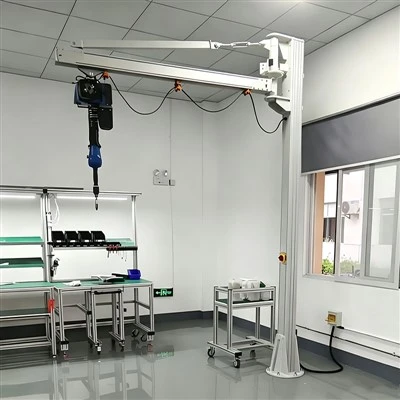
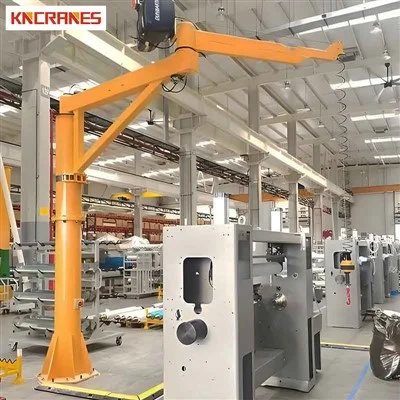
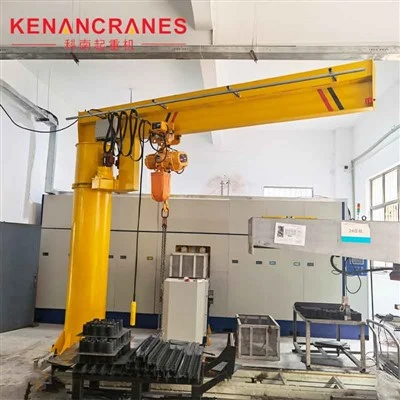
A floor mounted jib crane consists of a vertical column fixed to a baseplate, a horizontal jib arm that slews around the column, and a trolley-hoist assembly that travels along the arm. The column does not bear lifting loads directly. Its main function is to keep the jib arm at the proper working height and transfer the arm‑generated bending moment to the baseplate. Loads are then distributed into the foundation in three forms: vertical compression, horizontal shear and overturning moment. Since this crane relies fully on its own footing instead of shared building structures, you can place the lifting point according to your production needs, with no restrictions from existing column spacing, usable walls or roof‑truss load‑bearing capacity.
This structural independence explains why floor mounted jib cranes are widely selected for machine‑tool cells, welding bays, maintenance stations and other work zones. The lifting position can be arranged right above the working area, rather than being limited by where the closest structural support is available.

Baseplate Mounting Methods
Not every floor jib crane is anchored to the slab the same way. Three mounting approaches are used, and the choice affects both installation sequencing and future relocation options:
- Anchor-bolt baseplate on an existing slab. The column baseplate is drilled and fixed to a previously poured, load-verified concrete floor using chemical or mechanical anchor bolts. This method suits facilities with an adequate existing slab and is the fastest route to installation.
- Cast-in foundation-embedded baseplate. The baseplate, or an anchor cage connected to it, is set into fresh concrete before the pour, so the connection becomes an integral part of the foundation rather than a surface fixing. This approach is typically selected for higher capacity or longer outreach configurations, where anchor pull-out and shear resistance must be maximized.
- Sleeve-insert mounting. A steel sleeve is cast into the foundation, and the column is inserted, leveled with wedges or shims, and welded or grouted in place. This method separates the column from the first concrete pour, which simplifies alignment correction and allows the column to be removed and reset if the crane must later be relocated to a new baseplate position.
The correct method depends on the condition of the existing floor, the project schedule, the rated load case and whether future relocation is a realistic requirement - not on cost alone.
Load Path and Foundation Reactions
Every floor mounted jib crane transmits three distinct reactions into its foundation, and all three must be checked together, not in isolation:
|
Reaction |
Source |
Foundation Requirement |
|
Vertical load |
Rated load plus jib arm, trolley and hoist self-weight |
Adequate bearing capacity and slab thickness beneath the baseplate |
|
Horizontal shear |
Slewing acceleration, trolley travel and any side loading |
Anchor bolts or embedded sleeve sized for lateral resistance |
|
Overturning moment |
Load weight multiplied by outreach at the working radius |
Baseplate size, anchor spacing and reinforcement sufficient to resist tipping |
The overturning moment grows directly with outreach, which is why a longer jib arm at the same rated load always demands a larger baseplate footprint, deeper reinforcement or a heavier foundation mass than a shorter one. A foundation designed for one capacity-outreach combination cannot be assumed adequate for another without re-verification.
Technical Configuration Range
|
Parameter |
Typical Range for This Crane Class |
|
Rated capacity |
125 kg to 5,000 kg |
|
Outreach |
2 m to 10 m, lower for higher-capacity tiers |
|
Slewing angle |
Up to 360°, or a restricted sector where site obstructions require it |
|
Jib profile |
Low-headroom I-beam or box-section arm |
|
Slewing drive |
Manual as standard, electric slewing available for higher-frequency duty |
|
Trolley travel |
Manual, or electric for repeated positioning at speed |
|
Baseplate mounting |
Anchor-bolt, cast-in embedded, or sleeve-insert, per site condition |
Capacity and outreach are inversely linked on any cantilevered arm: the figures above describe the outer bounds of the product class, not a combination available simultaneously. The exact load-radius pairing, baseplate dimensions and anchor specification must be confirmed against the actual site foundation before an order is finalized.
Floor Mounted Jib Crane Hoist Compatibility
The jib arm functions as a rail for the hoisting unit rather than as a fixed lifting device. A floor mounted jib crane hoist is selected independently of the crane structure and matched to the rated capacity, required lifting speed, duty classification and control method:
- Electric chain hoist - standard choice for repeated, moderate-duty lifting with pendant or radio control.
- Wire-rope hoist - specified where capacity or lifting height exceeds typical chain-hoist limits.
- Manual chain block - appropriate for infrequent lifts where power supply at the point of use is impractical.
Hoist headroom, hook approach and trolley dimensions must be checked against the crane's low-headroom jib profile so that the full rated lift height remains usable beneath the arm.

Floor Mounted Jib Crane vs Other Mounting Types
A floor mounted jib crane is not interchangeable with every other jib configuration, and the mounting method should follow the site condition rather than a general preference:
- Versus a wall or beam-mounted jib crane - a floor unit carries its own load into a dedicated foundation, so it can be installed where no verified building structure exists. A beam or wall-mounted jib, by contrast, requires an existing structural member rated for the full crane load case.
- Versus a portable jib crane on a weighted base - a floor unit is a permanent installation once the anchor connection is made; a portable unit trades permanence for the ability to relocate the entire crane without foundation work.
Where a suitable structural beam or column already exists and floor space is limited, a beam-mounted configuration may be more efficient. Where the lifting point must move between locations, a portable base is the appropriate alternative. A floor mounted jib crane is the correct choice when the lifting point is fixed and no existing structure can be relied upon to carry the load.
Application Areas
- Machine-tool loading and unloading stations
- Welding and fabrication cells
- Maintenance bays for equipment servicing and component changeout
- Mold and die handling at a fixed workstation
- Warehouse and dispatch points requiring a dedicated, repeatable lifting zone
- Facilities without a suitable wall or overhead structural member for load transfer

Specification Checklist Before Ordering
A floor mounted jib crane cannot be sized from rated capacity alone. The following data should be confirmed before a proposal is finalized:
- Rated load, including the weight of hooks, slings and any below-the-hook attachment.
- Working radius, measured from the column centerline to the furthest intended hook position.
- Required hook height and available headroom, including hoist body dimensions.
- Slewing coverage, obstacle positions and any restriction on rotation angle.
- Duty cycle, including lifts per hour and total operating hours per shift.
- Existing floor and foundation condition, including slab thickness, concrete grade and reinforcement, or confirmation that a new foundation will be poured.
- Preferred baseplate mounting method, based on installation schedule and any future relocation requirement.
Installation and Foundation Preparation
The foundation is a structural component of the crane, not a separate civil-works item to be finalized afterward. Baseplate dimensions, anchor bolt pattern, embedment depth and concrete specification must be derived from the confirmed load case - vertical load, horizontal shear and overturning moment at the rated outreach - before the foundation is poured or the existing slab is drilled. After installation, column plumb, jib rotation clearance, trolley travel and hoist operation should be verified before the crane is placed into service, and periodic inspection should follow the applicable local lifting-equipment requirements.
FAQ
What is a floor jib crane?
A floor jib crane is a rotating cantilever lifting system with a column fixed to its own baseplate and dedicated concrete foundation, distinguishing it from wall-mounted, beam-mounted and portable jib crane types that rely on an existing structure or a movable base.
What is the difference between a floor mounted jib crane and a floor mount jib crane?
Both refer to a jib crane whose column is anchored to its own foundation rather than to a building wall, beam or column.
Does a floor mounted jib crane require a dedicated foundation?
Yes. The baseplate must transfer vertical load, horizontal shear and overturning moment into a foundation sized for the specific capacity and outreach combination. An undersized or unverified foundation is the most common cause of instability in this crane class.
Can a floor mounted jib crane be installed on an existing slab?
It can, provided the existing slab thickness, concrete grade and reinforcement are verified as adequate for the calculated reactions. Where the existing floor cannot meet this requirement, a cast-in or sleeve-insert foundation should be used instead.
What capacity and outreach can a floor mounted jib crane cover?
Configurations across this product class typically span 125 kg to 5,000 kg in rated capacity and 2 m to 10 m in outreach, with longer outreach settings corresponding to lower permissible capacity. The specific combination must be confirmed against the foundation design.
What type of hoist works with a floor mounted jib crane?
An electric chain hoist, wire-rope hoist or manual chain block can be mounted to the jib arm, selected according to the rated capacity, required lifting speed, duty classification and available headroom beneath the low-headroom jib profile.
Hot Tags: floor jib crane, China floor jib crane manufacturers, suppliers, factory, 1 Ton Electric Hoist, Column Mounted Jib Crane, Jib Crane By Types, Pillar Mounted Jib Crane, Wall Bracket Jib Crane, Wall Mounted Jib Crane
Previous
Lifting Jib CraneYou Might Also Like



Send Inquiry