




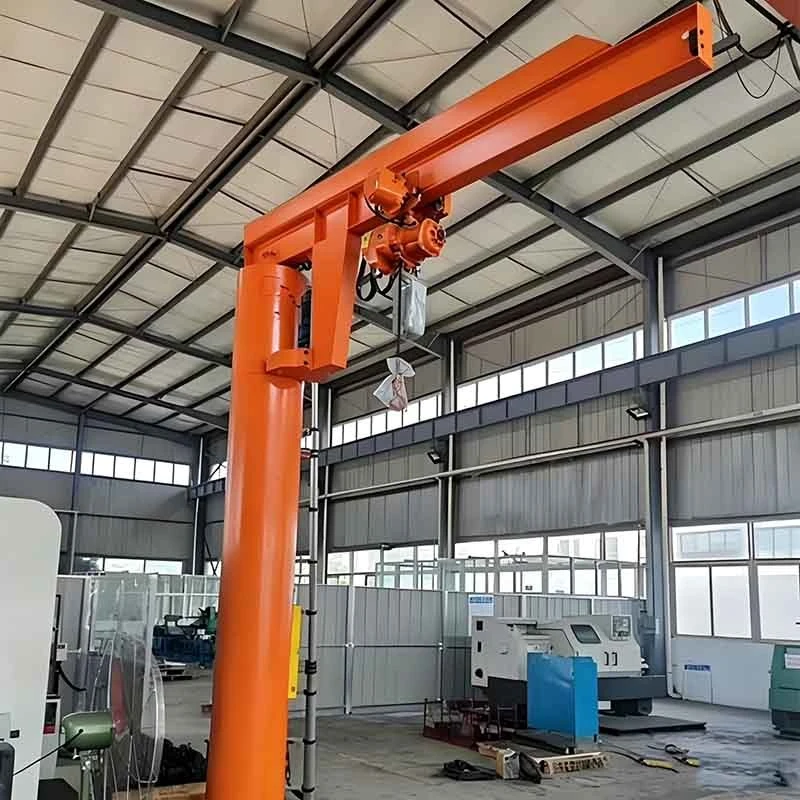
Lifting Jib Crane
SWL:250kg-10 Ton
Rotation angle:90-360
Mounting type:Floor-mounted/Wall-mounted
Drive mode:Manual push/rotation or motorized
Power supply:380V/220V;50HZ;3-phase
Product Overview
A lifting jib crane works as a rotating cantilever‑style lifting device, designed to transfer materials over a set working radius for one dedicated workstation or work cell. Its main components include a horizontal or gently tilted jib arm rotating on a vertical pivot, plus a travelling hoist - available as electric chain hoist, wire rope hoist or manual chain block - which slides along the arm to complete lifting and horizontal positioning.
Bridge and gantry cranes work across a rectangular zone determined by runway length and span, while a jib crane covers a full or partial circular area around its pivot. That is why it acts as a point‑of‑use lifting tool, instead of a material‑handling system covering the whole workshop floor. Most installations go with one machine tool, assembly station, loading dock or maintenance bay that needs frequent, localized load‑handling operations.
Lifting jib cranes are classified primarily by mounting method, which determines the load path into the building structure or foundation:
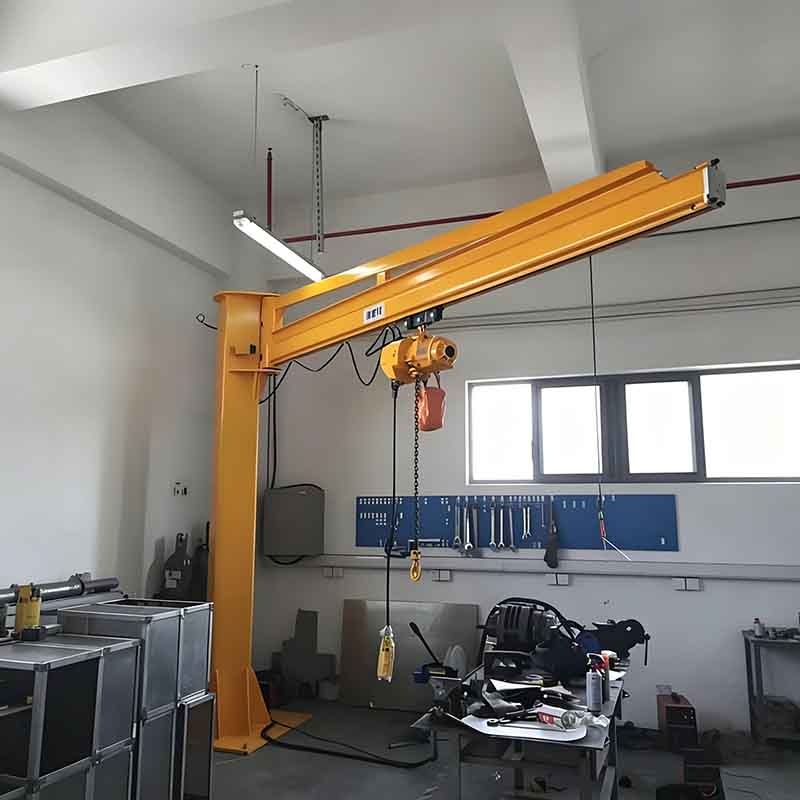
- Floor-mounted jib crane - the column is set into an independent concrete foundation or base frame, structurally independent of the building.
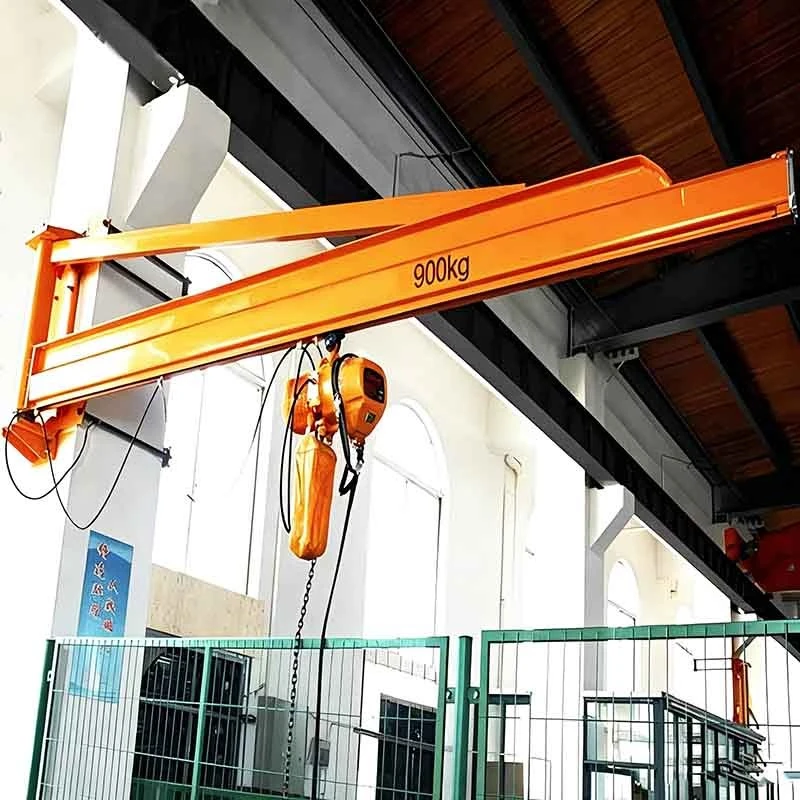
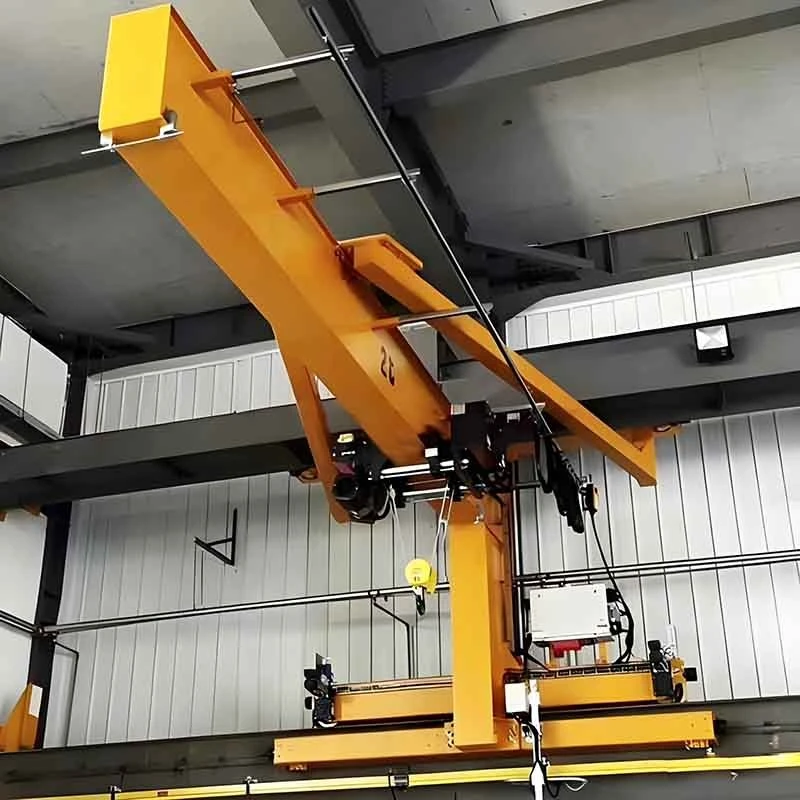
- Wall-mounted jib crane - the jib and bracket assembly are fixed to an existing structural column or wall, transferring load into the building frame.
Selection between these configurations depends on available floor space, building structural capacity, headroom, and the required rotation angle - covered in the specification section below.


Structural Configuration & Working Principle
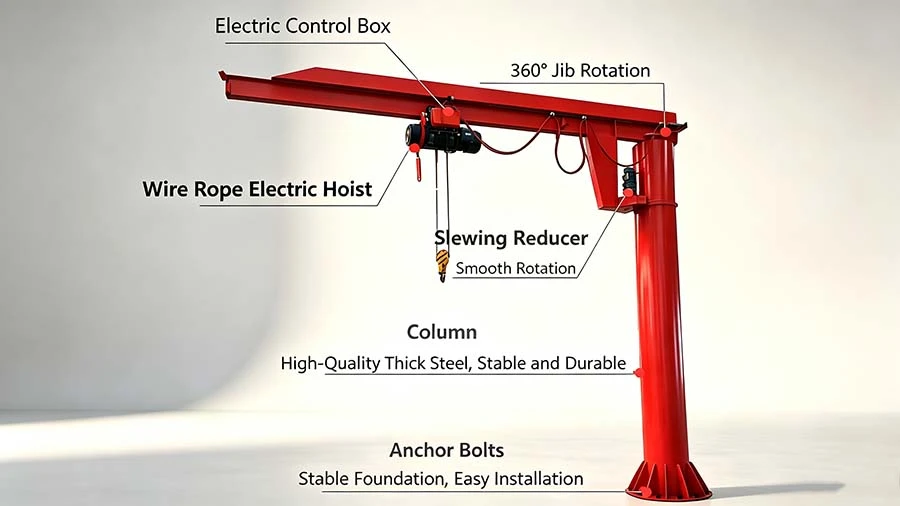
A lifting jib crane is built from four functional groups. Each group can be specified independently to match a given application, which is why capacity, span, and rotation should always be confirmed together rather than treated as separate line items.
1. Mounting interface (foundation or structural connection)
Transfers the full overturning moment and vertical load generated by the jib and its rated load into the ground or building structure. For floor-mounted units, this is a reinforced concrete foundation sized to the crane's base moment; for wall-mounted units, it is a bracket bolted or welded to an existing column with adequate load rating.Foundation and anchor design must be confirmed against project structural drawings and local building code - generic catalog dimensions should not be used as final construction values.
2. Rotating column and slewing mechanism
The vertical column carries the jib and rotates on a bearing assembly (typically a slewing ring bearing on medium-to-heavy duty units, or a bushing arrangement on lighter-duty units). Rotation may be manual (operator-pushed) or motorized, and is mechanically limited by stops or electrical limit switches to the rated working arc - commonly up to 180 deg for wall-mounted units and up to 270-360 deg for floor-mounted units, subject to site clearance.
3. Jib arm (boom)
A fabricated steel beam, typically of I-section or box-section design, cantilevered from the column. The jib carries a trolley or fixed suspension point for the hoist. Arm length determines the working radius and is a primary input for foundation sizing, since bending moment increases with both arm length and rated load.
4. Hoisting and trolley system
The lifting function is provided by an electric chain hoist, wire rope hoist, or manual chain block mounted on a push-type or geared travel trolley, or in simple manual configurations, a fixed hook point. The trolley travels along the lower flange of the jib, allowing radial (in-and-out) positioning of the load in addition to the rotational movement of the arm.
Key Specifications & Selection Criteria
The table below summarizes the variables that define a lifting jib crane configuration. Exact figures vary by manufacturer and duty requirement; use these as a reference framework when preparing a technical inquiry, and confirm final values against project-specific load, layout, and structural conditions.
|
Parameter |
Reference Range / Notes |
|
Rated load capacity (SWL) |
Commonly available from light-duty (below 500 kg) to heavy-duty (multiple tonnes); exact capacity to be confirmed per application |
|
Working radius / arm length |
Determined by workstation layout and required reach; longer arms reduce net lifting height and increase foundation loading |
|
Rotation angle |
Wall-mounted: typically up to 180 deg; floor-mounted: typically up to 270-360 deg, depending on site obstructions |
|
Mounting type |
Floor-mounted (independent foundation), wall-mounted (structural bracket) |
|
Hoist type |
Electric chain hoist, electric wire rope hoist, or manual chain block, selected by duty cycle and lift height |
|
Drive mode |
Manual push/rotation, or motorized slewing and hoisting for higher-cycle applications |
|
Duty classification |
Reference to applicable crane duty class standards (e.g., FEM or equivalent) should be confirmed based on operating cycles and load spectrum |
|
Power supply |
To be confirmed per site electrical specification where motorized hoist or slewing drive is used |
|
Foundation / anchor requirement |
Sized to the crane's base moment (capacity x arm length); requires structural verification independent of the crane supplier's standard drawing |
Selection checklist for procurement and engineering teams:
- Confirm the maximum load to be lifted, including the weight of any lifting attachment (sling, spreader beam, or fixture).
- Determine the required working radius based on the layout of the workstation, machine, or loading area.
- Verify available headroom, since hook height is reduced by hoist body height and any trolley clearance.
- Identify the mounting condition - is there an adjacent column/wall rated to carry the load, or is an independent foundation required?
- Estimate duty cycle (lifts per hour, hours per shift) to determine whether a manual, electric-manual hybrid, or fully motorized configuration is appropriate.
- Confirm site power supply and control preference (pendant, radio remote, or fixed pushbutton station) if a motorized hoist is specified.
Typical Application Scenarios
Machine tool loading and unloading - Positioned adjacent to a CNC machine, lathe, or press, a lifting jib crane allows an operator to load raw stock and unload finished parts without waiting for an overhead crane to become available, reducing idle machine time.
Assembly and workbench stations - On assembly lines handling motors, pumps, gearboxes, or subassemblies, a jib crane mounted between two adjacent stations lets one unit service both work areas within its rotation arc.
Warehouse and loading dock support - At a dock door or staging area, a floor-mounted or mast-type unit supports palletized or crated goods handling where a full bridge crane installation is not justified by volume.
Maintenance and workshop bays - In a maintenance bay, a jib crane mounted on an existing structural column supports engine, gearbox, or component removal during repair work, operating independently of the main production crane.
Container and bulk-material handling support points - Where a bridge or gantry crane covers the primary handling area, a wall-mounted jib crane installed along the perimeter provides supplementary point lifting for tooling, spare parts, or maintenance equipment without interrupting the main crane's operation.
Combined use with overhead cranes - In facilities already served by a bridge crane, jib cranes are frequently added at fixed workstations to offload repetitive, localized lifts from the main crane, improving overall material flow and reducing bridge crane cycle time.

Product Advantages
- Localized coverage without full-bay installation. A jib crane services a defined work radius without requiring runway beams or building-wide crane infrastructure, making it suitable for retrofitting into existing facilities.
- Lower structural load compared to bridge crane systems. Because the service area is limited to the jib's rotation arc, the supporting structure and foundation requirements are generally smaller than those of an equivalent-capacity bridge crane.
- Independent operation. A dedicated jib crane at a workstation operates without competing for crane time with other production areas, which is a common bottleneck when a single bridge crane serves multiple stations.
- Configurable mounting to fit existing structure. Wall-mounted, floor-mounted, and mast-type options allow the crane to be matched to the building's existing columns, available floor space, and headroom, rather than requiring a fixed building layout.
- Scalable hoist selection. The hoist and trolley can be specified independently of the jib structure, allowing manual, electric-manual, or fully motorized configurations to match duty cycle and budget.
Frequently Asked Questions
Q1: What is the difference between a floor-mounted and a wall-mounted jib crane?
Floor‑mounted jib cranes rest on their own independent foundation and require no support from the building structure. This setup delivers a wider rotation range, normally reaching 360 deg, though on‑site foundation work has to be completed before installation.Wall‑mounted jib cranes are attached to an existing structural column or wall. No separate foundation construction is needed. Rotation is generally confined to the side facing away from the wall, with a typical limit of 180 deg. The supporting structure must be capable of safely bearing this additional load.
Q2: Does a lifting jib crane require a concrete foundation?
Floor-mounted and mast-type jib cranes generally require a reinforced concrete foundation or baseplate sized to the crane's base moment (a function of rated load and arm length). Wall-mounted units instead require verification that the existing column or wall can carry the applied load and moment. Foundation and anchor design should always be confirmed by a structural engineer using the specific crane loading data, not assumed from a generic drawing.
Q3: How is the rotation angle of a jib crane determined?
Rotation angle is set by the mounting type and by physical obstructions at the installation site, such as adjacent walls, columns, or equipment. Wall-mounted units are commonly limited to approximately 180 deg due to the wall itself; floor-mounted and mast-type units can typically achieve 270-360 deg where clearance allows. Mechanical stops or limit switches are used to fix the working arc during installation.
Q4: Can a manual jib crane be upgraded to a motorized one later?
In many cases, a manually rotated and manually hoisted jib crane can be upgraded by replacing the hoist with an electric unit and, where the column and bearing design allow, adding a motorized slewing drive. This should be confirmed against the original structural design, since motorized operation can increase duty cycle and dynamic loading compared to manual use.
Q5: What hoist types are compatible with a lifting jib crane?
Electric chain hoists, electric wire rope hoists, and manual chain blocks can all be mounted on a jib crane trolley, provided the trolley and jib beam are rated for the hoist's weight and the combined load. Hoist selection is generally based on required lift height, duty cycle, and whether motorized operation is needed.
Q6: How is load capacity affected by working radius?
For a given jib crane structure, rated capacity is fixed at the design working radius; it is not adjustable by simply extending the arm on-site. Increasing working radius on a new order increases the bending moment on the jib and the overturning moment on the foundation, which may require a heavier structure or larger foundation to maintain the same rated load. Any change to radius should be reviewed with the supplier before ordering.
Q7: What duty class should be selected for a lifting jib crane?
Duty classification should reflect actual operating conditions - number of lifting cycles per hour, average load relative to rated capacity, and hours of use per shift. Light, intermittent use (occasional maintenance lifts) calls for a lower duty classification than continuous production use (repetitive loading of a CNC machine). Applicable duty class standards and the corresponding structural design should be confirmed with the supplier based on the intended operating profile.
Hot Tags: lifting jib crane, China lifting jib crane manufacturers, suppliers, factory, 1 Ton Electric Hoist, Column Mounted Jib Crane, Jib Crane By Types, Pillar Mounted Jib Crane, Wall Bracket Jib Crane, Wall Mounted Jib Crane
Previous
Pillar Mounted Jib CraneNext
Floor Jib CraneYou Might Also Like



Send Inquiry