




Pillar Jib Crane
Max capacity: 5,000 kg
Max outreach: 10 m
Slewing range: 360°
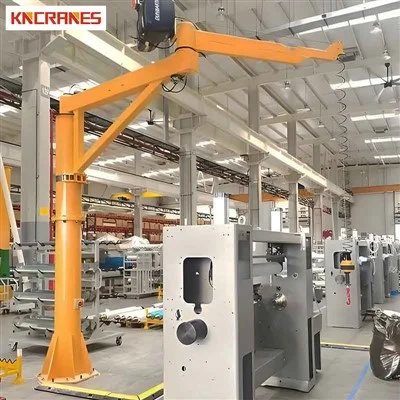
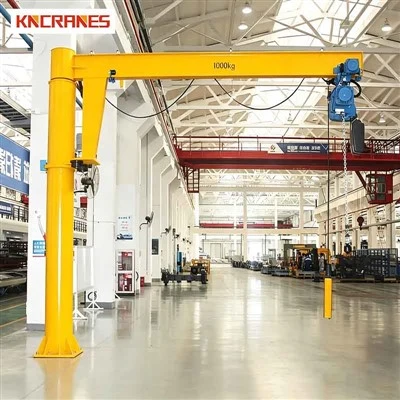
Pillar jib crane is an independent floor bearing lifting system for fixed workstation hoisting. Different from wall-mounted jib cranes and overhead travelling cranes, it can be arranged at arbitrary floor positions without relying on building load-bearing walls, structural columns or overhead rails.
The crane forms an independent load-bearing system: solid steel pillar bears overall loads, extendable jib forms circular working coverage, and matched hoists perform vertical lifting within the working zone.
Pillar-mounted jib crane is not a unified standard product. The complete set consists of matched jib section, rated capacity, outreach, slewing drive, travelling trolley, lifting unit, cable routing and foundation connection.
Configuration shall be confirmed by joint verification of working radius and load travelling path. Capacity-only selection ignoring site conditions will lead to mismatched equipment despite nominal load compliance.

Core Performance Characteristics
- Independent floor support: No load transfer to building structures, applicable to workshops without available wall supports.
- Four structural series: I-beam, C-rail and suspension beam types covering light, medium and heavy lifting conditions.
- Optional drive units: Manual or electric slewing and trolley travel adaptable to intermittent low-cycle or continuous high-cycle operation.
- Low-headroom beam design: Maximizes available vertical lifting space for workshops with limited overhead clearance.
- Customized foundation solutions: Compatible with existing reinforced concrete slabs or independent reinforced concrete bases for heavy long-outreach models.
- Compact layout: Concentrates lifting capacity at designated stations and reduces cross-plant forklift transit.
Application Scope
The series is widely adopted for cyclic fixed-point lifting in various industrial sectors:
- CNC machining, stamping, cutting and metal fabrication: Raw material feeding and finished parts unloading
- Assembly lines for motors, gearboxes, tooling fixtures, welded components and semi-finished products
- Equipment maintenance workshops: Disassembly, replacement and precise positioning of components
- Welding, assembly and inspection areas insufficiently covered by overhead cranes
- Mold storage, warehouse transfer stations and small loading zones requiring independent lifting supports
Structural Types of Pillar Jib Crane Series
Four structural configurations are provided to balance payload, outreach, slewing range and headroom. All parameters represent standard specification envelopes and cannot be arbitrarily combined. Combined load calculation is required before model confirmation for special working conditions.
| Configuration | Applicable Conditions | Standard Technical Parameters |
|---|---|---|
| DJB-CNN: Manual I-beam jib crane | General medium-duty hoisting with manual rotation meeting operational requirements | Max capacity: 2,000 kg; Max outreach: 10 m; Standard slewing angle: 270° |
| DJB-PNN-S: Electric slewing I-beam jib crane | High-capacity and long-outreach working conditions requiring stable motor-driven rotation | Max capacity: 5,000 kg; Max outreach: 10 m; Slewing range up to 360° |
| KJB-CNN: Manual C-rail jib crane | Light compact lifting, lightweight structure prioritized to save vertical space | Max capacity: 1,000 kg; Max outreach: 6 m; Standard slewing angle: 270° |
| DJB-HNN: Suspension jib crane | Working sites with special layout requiring suspended beam structure | Max capacity: 2,000 kg; Max outreach: 8 m; Standard slewing angle: 270° |
Working Radius Planning & Load Condition Calculation
Three position verifications shall be completed before steel structure confirmation:
- Pickup point: Reserved clearance for slings, lifting hooks and auxiliary fixtures.
- Transfer track: Sweeping path of suspended loads during jib rotation and trolley movement.
- Setting-down point: Reserved space for accurate unloading and safe hoist retraction.
Layout verification is critical for production lines with multiple adjacent machine tools and narrow bays. Excessively long jib with unreasonable sweeping track will form restricted operation zones. Proper pillar positioning with shorter jib can fully cover all lifting points and lower structural stress simultaneously.

Jib Beam & Slewing Drive Configuration Selection
Manual I-Beam Arrangement (DJB-CNN)
DJB-CNN adopts I-beam jib matched with manual slewing, suitable for working conditions without frequent repeated positioning. Its specification covers 2,000 kg rated capacity and 10 m maximum outreach subject to combined load and outreach calculation.
Electric-Slewing I-Beam Arrangement (DJB-PNN-S)
DJB-PNN-S is designed for heavy-load operation requiring motorized rotation. Electric slewing serves as a core motion control component rather than optional auxiliary decoration. It is mandatory for long outreach, large load inertia, high-frequency positioning or limited operating space where manual rotation causes instability. The model supports 5,000 kg maximum capacity, 10 m outreach and full 360° rotation.
C-Rail Arrangement (KJB-CNN)
KJB-CNN C-type jib applies to light compact lifting. Lightweight beam reserves sufficient vertical headroom and matches small-size travelling hoists, with 1,000 kg maximum capacity and 6 m maximum outreach.
Suspension-Beam Arrangement (DJB-HNN)
DJB-HNN suspended beam is an alternative structural scheme with 2,000 kg rated capacity and 8 m maximum outreach. Final applicability shall be confirmed according to hook travelling track, site layout and customized design.

Integrated System Design of Pillar Jib Cranes
Steel structures define coverage range, while overall lifting performance relies on matching between jib and lifting equipment. Complete customized scheme integrates design of all system components as follows:
| System Element | Engineering Verification Items |
|---|---|
| Hoist | Rated capacity, lifting height, lifting speed and control mode |
| Trolley | Positioning accuracy of manual travelling or necessity of motor-driven trolley |
| Slewing Drive | Available rotation sector and necessity of electric slewing conforming to production flow |
| Cable Routing | Protection scheme of power and control cables during jib travelling and rotation |
| Jib Geometry | Beam type matching hook track, required outreach and bearing capacity |
| Base Connection | Bearing capacity assessment of original slab or demand for independent foundation |
Electric chain hoists, manual lifting tools and pneumatic lifting equipment are optional for diverse production environments. Festoon cable systems and C-rail cable carriers ensure neat cable layout during equipment operation. All confirmed configurations shall be marked on construction drawings to define travel limits and safe operation zones before commissioning.

Technical Frequently Asked Questions
DJB-PNN-S electric slewing I-beam jib crane supports maximum 360° rotation. Actual available rotation angle will be rechecked against cable layout, matched hoist and site obstacles before manufacture.
Larger outreach generates higher structural stress and foundation bearing pressure under jib-tip suspended loads. Allowable rated capacity is correlated with outreach, lifting height, working duty cycle and foundation design. Each project requires combined load evaluation; separate matching of maximum published capacity and outreach is prohibited.
C-rail jib adapts to light compact lifting requiring low self-weight and limited outreach. KJB-CNN series supports maximum 1,000 kg capacity and 6 m outreach.
No. Electric slewing only assists jib rotation. Operators shall maintain standardized control over suspended loads, lifting attachments, travelling tracks and safety isolation zones. Electric slewing selection is determined by production flow, load characteristics and positioning accuracy requirements.
Installation on existing slabs is permitted only after full bearing capacity assessment of slabs and anchors against crane reaction loads. Slab thickness alone cannot guarantee safe operation. Verification covers concrete condition, reinforcement layout, anchor arrangement, jib dimension and actual working load conditions.
Formal technical specification defines selected model, rated capacity under specified outreach, lifting height, slewing range, hoist & trolley configuration, power & control demand, cable routing, base connection and complete foundation design documents.
Hot Tags: pillar jib crane, China pillar jib crane manufacturers, suppliers, factory, 1 Ton Electric Hoist, Column Mounted Jib Crane, Jib Crane By Types, Pillar Mounted Jib Crane, Wall Bracket Jib Crane, Wall Mounted Jib Crane
Previous
Beam Mounted Jib CraneYou Might Also Like


Send Inquiry