


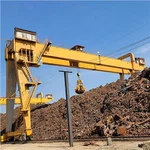


Column Mounted Jib Crane
Rated capacity:Up to 5,000 kg
Outreach:Up to 10 m
Slewing range:Up to 360-degree rotation
Jib profile:Low-headroom I-beam profile
Hoist travel:Manual or optional electric trolley travel
Slewing drive:Manual or optional electric slewing drive
Column Mounted Jib Crane for Controlled Workstation Lifting
The Column Mounted Jib Crane is a free-standing lifting system engineered for repetitive material handling within defined work zones. A rigid column, horizontal jib arm and travelling hoist arrangement create direct coverage around a machine, assembly station, fabrication bay or loading point. The configuration reduces unnecessary fork-truck movement, shortens manual transfer paths and gives operators controlled access to loads where overhead-crane coverage is not required.
The DJB-PNN-S configuration shown is an electric slewing jib crane designed around a column-mounted structure. Its low-headroom jib profile supports efficient hook travel, while the rotating arm provides broad working coverage around the column. Manual slewing, electrically assisted slewing and electrically powered trolley travel can be selected according to the load profile, operating frequency and operator-handling requirement.

Technical Configuration at a Glance
|
Item |
DJB-PNN-S configuration shown |
|
Crane type |
Electric column mounted slewing jib crane |
|
Rated capacity |
Up to 5,000 kg |
|
Outreach |
Up to 10 m for configurations below 1,000 kg |
|
Slewing range |
Up to 360-degree rotation |
|
Jib profile |
Low-headroom I-beam profile |
|
Hoist travel |
Manual or optional electric trolley travel |
|
Slewing drive |
Manual or optional electric slewing drive |
|
Foundation interface |
Chemical anchor bolts; concrete foundation recommended for heavy-load applications |
Configuration note: Capacity, outreach, lifting height, duty classification, hoist type, power supply and foundation design must be confirmed for each project. The stated envelope is derived from the supplied product information and is not a universal rating for every installation.
Built for Defined Lifting Zones
A column mounted jib crane concentrates lifting capacity where production requires it most. The independent column transfers crane forces to the foundation rather than to the building structure, making it suitable for facilities where wall support is unavailable or where the lifting station must be located away from structural columns. The jib arm rotates around the column to cover a circular handling area, allowing a suspended load to be lifted, moved along the beam and positioned with a compact operating footprint.
This arrangement is appropriate for machine feeding, welding and fabrication cells, maintenance workshops, mould handling, assembly stations, warehouse transfer points and industrial loading areas. For processes that demand repeatable positioning, the optional electric drives can reduce operator effort and support smoother load movement across the designated working radius.

Structural Features That Support Reliable Handling
Floor-Supported Column Structure
The free-standing steel column establishes an independent lifting point. It is anchored to a prepared concrete foundation, allowing the crane to be positioned according to process flow rather than building-wall availability. Foundation assessment remains essential because anchor arrangement, concrete condition and overturning forces vary with capacity, outreach and duty.
Low-Headroom I-Beam Jib
The I-beam jib is designed to preserve useful hook path beneath the beam. In workstations with limited vertical clearance, a low-headroom layout can improve usable lifting height and simplify the movement of tall components, tooling or containers.
Controlled Slewing and Trolley Movement
The crane can be configured for manual movement where operating frequency is moderate, or with electric slewing and trolley travel where load cycles, outreach or handling precision justify powered assistance. The correct drive arrangement should be selected from the actual load, travel distance, duty cycle and operator workflow rather than from capacity alone.
Hoist Compatibility
A chain hoist or wire-rope hoist can be integrated when matched to the required capacity, lifting speed, lift height, classification and control method. Hoist selection should also consider the available headroom, hook approach, pendant position and electrical supply at the installation point.

Selection Data Required for Engineering Review
A correctly specified Column Mounted Jib Crane begins with the working condition, not only the maximum load. Provide the following information for an engineering proposal:
- Rated load, including the weight of below-the-hook devices and lifting attachments.
- Required outreach from the column centerline to the hook working position.
- Required under-beam height and total lift height.
- Slewing coverage, obstacle locations and required approach angles.
- Number of lifts, average operating hours and duty classification.
- Hoist preference, lifting speed, control voltage and local power supply.
- Concrete foundation dimensions, thickness, reinforcement condition and available installation area.
- Indoor or outdoor environment, corrosion exposure, ambient temperature and any process-specific safety requirements.
Why the Column Mounted Jib Crane Fits Industrial Workstations
Dedicated lifting coverage: serves a local handling point without consuming the full travel path of an overhead crane.
Flexible placement: the floor-mounted column allows installation where building columns or suitable wall supports are absent.
Efficient load paths: lift, traverse and slewing motions keep transfer distances short within the assigned work envelope.
Scalable operation: manual and electric movement options support different loads, spans and production rhythms.
Clear engineering interface: capacity, outreach, power and foundation can be matched to the actual facility condition.
Installation and Operating Considerations
The foundation is a structural part of the crane system. Before installation, verify the concrete grade, slab thickness, reinforcement, anchor layout and clearance around the base plate. For heavy-load or long-outreach configurations, a dedicated concrete foundation may be necessary. Chemical anchors must be selected and installed in accordance with the approved project design and the anchor manufacturer instructions.
After mechanical installation, the crane should be checked for column alignment, jib rotation, trolley travel, hoist operation, limit functions and electrical connections. Commissioning and periodic inspection must follow the applicable local lifting-equipment rules and the final technical documentation. Operators should be trained in rated-load limits, correct sling use, load control and exclusion-zone practice.

Column Mounted Jib Crane FAQ
What is a column mounted jib crane?
A column mounted jib crane is a free-standing crane with a vertical column anchored to the floor and a horizontal rotating jib arm. A hoist and trolley move the load along the arm, while the arm slews around the column to cover a defined work area.
What is the difference between a column mounted jib crane and a wall-mounted jib crane?
A column mounted jib crane is supported by its own floor-mounted column. A wall-mounted jib crane transfers load to an existing wall or building column. The column-mounted design is usually selected when an independent lifting station is needed or when the available building structure is not suitable for crane loading.
Can this crane rotate through 360 degrees?
The supplied DJB-PNN-S product information indicates a maximum slewing range of up to 360 degrees. The achievable rotation for a specific installation depends on the selected configuration, electrical arrangement, cable management and surrounding obstacles.
What capacity and outreach are available?
The supplied product information identifies capacities up to 5,000 kg and outreach up to 10 m for configurations below 1,000 kg. Final capacity and outreach must be designed as a combined load case because increasing outreach changes the structural and foundation demand.
Is electric slewing necessary?
Electric slewing is generally considered where loads are substantial, the outreach is long, or the work cycle requires repeatable and lower-effort positioning. Manual slewing may be appropriate for lighter loads and intermittent operation. The final choice should be based on operating frequency, load control and safety requirements.
Can a columnn mounted jib crane be customized?
Yes. The search phrase "columnn mounted jib crane" is commonly used as a spelling variation of column mounted jib crane. The equipment can be engineered around project-specific capacity, outreach, lifting height, slewing range, hoist, control method, power supply and foundation condition. A technical review is required before confirming a configuration.
Request a Project-Specific Lifting Solution
Submit the required capacity, outreach, lifting height, operating environment and installation details to obtain a Column Mounted Jib Crane configuration matched to the workstation. A complete proposal should define the crane structure, hoist arrangement, movement drives, electrical scope, anchor/foundation requirements and applicable technical documentation before manufacture.
Contact Us To Obtain The Solution
Hot Tags: column mounted jib crane, China column mounted jib crane manufacturers, suppliers, factory, 1 Ton Electric Hoist, Column Mounted Jib Crane, Jib Crane By Types, Pillar Mounted Jib Crane, Wall Bracket Jib Crane, Wall Mounted Jib Crane
Previous
Pillar Jib CraneYou Might Also Like


Send Inquiry