





Industrial Vacuum Lifting System
Safe Working Load:80kg-20t
Power:AC 208–460 V, DC 12 V / 24 V / 48 V
KNCRANES industrial vacuum lifting systems cater to sheet metal, architectural & processed glass, coils, composite panels, stone, plus custom workpieces for individual projects. Our product range comprises passive self-suction lifters, AC and DC vacuum lifters, pneumatic workstation units, and modular assemblies equipped with manual, electric or hydraulic tilt and rotation.
Handling configuration for the actual load
Our vacuum lifters use suction cups to handle sheets, panels and other flat materials. The frame can be adjusted for different load sizes. For long or heavy loads, the cups are spread over a larger area and extra vacuum support can be added if required.
The right setup depends on the material and its surface. Dust, oil, rough finishes, curved surfaces and temperature can all affect gripping force. Smooth metal sheets need a different solution from stone, coated boards, curved glass or porous materials.
System range and representative parameters
|
Product family |
Typical workpiece or process |
Safety working load |
Power / air supply |
Movement or configuration |
Representative technical details |
|
HP-WDL non-powered series |
Smooth, dense sheet materials; machine loading |
80-2,000 kg |
Self-suction; no external power |
Horizontal handling |
1-6 cups; representative cup sizes from 200 to 450 mm; direct crane-hook connection |
|
HP-BS sheet series |
Laser-cutting line loading and horizontal sheet transfer |
500-2,500 kg |
AC 208-460 V (±10%), DC 12 V, or compressed air 0.6-0.8 MPa |
Manual or remote control |
6-12 cups; AC configuration for continuous duty, DC configuration for wide crane travel |
|
HP-BL heavy-duty sheet series |
Large carbon steel and stainless steel plates |
3-20 t |
DC 12 V or AC 208-460 V (±10%) |
Manual or remote control |
16-20 cups in listed examples; adjustable cup positions; multi-vacuum configurations available |
|
HP-SFX / HP-DFX / HP-YFX glass series |
Glass, insulated glass and curtain-wall installation |
200 kg-10 t, by series |
DC 12 V, DC 24 V or DC 48 V |
Manual, electric or hydraulic tilt/rotation |
Up to 0-90° tilt and 0-360° rotation on applicable series; single or dual vacuum systems by model |
|
HP-QF pneumatic series |
Fixed stations in glass processing lines |
150-500 kg |
Compressed air 0.6-0.8 MPa |
Pneumatic tilt and/or rotation |
2-6 cups; compatible with jib cranes, wall cranes or bridge rails |
|
HP-C coil series |
Aluminium, copper and steel coil handling |
200-3,000 kg |
AC 208-460 V (±10%) |
0-90° electric turning on applicable configurations |
Single- or multi-chamber suction arrangement for coil diameter variation |
|
HP-W / HP-M series |
Composite panels, stone and special surfaces |
200 kg-20 t, by family |
Multiple power options |
Tilt and rotation as required |
Cup interface selected for panel surface, stone texture or process requirement |
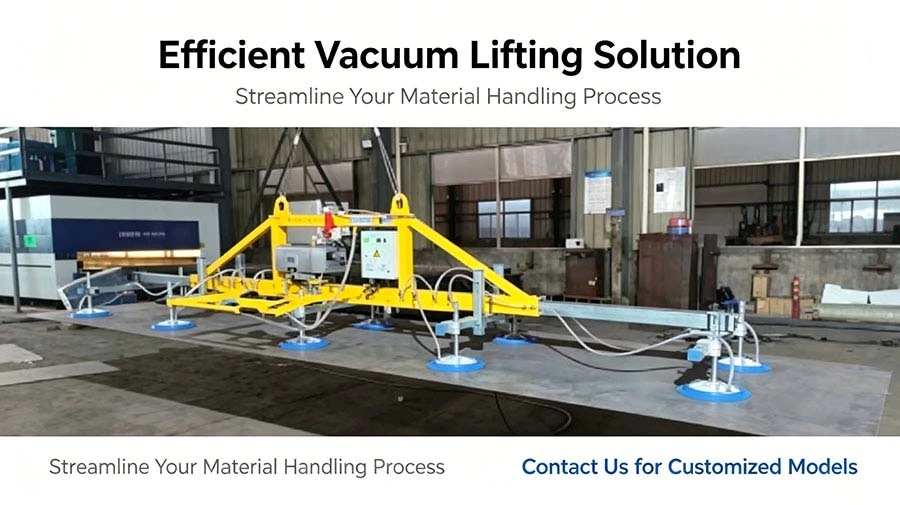
Heavy-duty vacuum lifters for production and installation work
Heavy-duty vacuum lifters are built for large plates that are difficult to handle safely by hand. They are also suitable for repeated crane lifting where a consistent cup layout is required.The HP-BL range handles plate loads from 3 t to 20 t. Depending on the model, it uses 16 to 20 suction cups and is available with DC or AC power. AC systems suit uninterrupted production positions; DC systems support movement across a wider crane coverage area without an external trailing supply.
For large glass, hydraulic HP-YFX configurations provide modular suction groups, DC 24 V power, remote control and applicable 0-90° hydraulic tilt with 0-360° hydraulic rotation. Curved-glass configurations use adjustable or self-adapting cup groups according to the series and curvature requirement.
Supporting structure and process integration
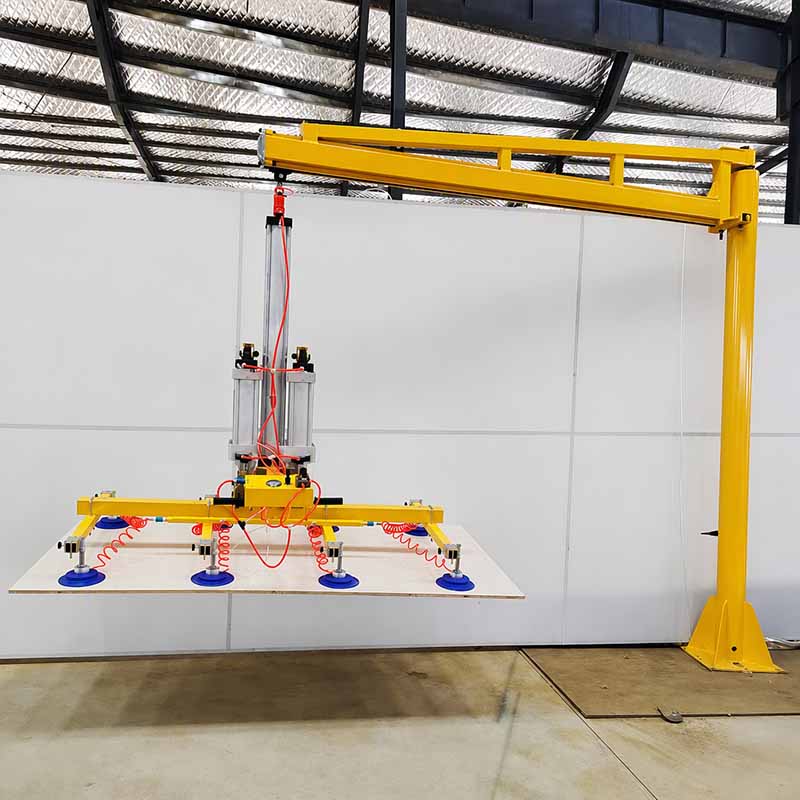
The vacuum lifter is only one part of the handling cell. A floor-mounted jib crane, wall-mounted crane or bridge rail can be selected for the travel envelope and operating frequency. The listed HP-LZ jib crane range covers 250-5,000 kg, with 1-6 m lifting height and 1-5 m rotation radius. HP-QS bridge rails are available from 250-2,000 kg, with listed spans up to 10 m.
For fixed stations, pneumatic lifters can be matched to the crane or rail rather than treated as standalone devices. This reduces unnecessary hoist travel and keeps loading, edging, laminating, furnace unloading or sealing operations within a defined working zone.
Selection data required for an industrial vacuum lifting system
To recommend a suitable industrial vacuum lifter, please provide the following information:
- Load material and surface condition
- Load dimensions, weight and centre of gravity
- Required lifting orientation and handling process
- Working environment, including temperature, dust, oil or possible air leakage
- Available power supply
- Required lifting speed, travel motion and control method
- Crane type, lifting connection and available hook height
- Installation, testing and commissioning requirements
FAQ
Where to buy industrial vacuum lifters online for a specified lifting process?
Start with a technical enquiry that includes the workpiece drawing, material, surface condition, maximum mass, dimensions, required movement and available lifting structure. An online enquiry without this information cannot establish a safe final configuration.
What is the difference between a non-powered and powered industrial vacuum lifter?
Non-powered self-suction equipment is intended for compatible smooth, dense workpieces and does not require an external electrical supply. Powered systems use AC, DC or compressed air and are selected for the duty cycle, movement range, surface condition and required vacuum architecture.
Can one system lift both sheet metal and glass?
Only when the cup interface, vacuum layout, structural geometry and rated working load are verified for both materials. A lifter configured for sheet loading should not be assumed suitable for glass installation without a separate technical assessment.
Are vacuum tube lifters for use in harsh industrial environments the same as vacuum spreader lifters?
No. Vacuum tube lifters and crane-suspended vacuum spreader lifters use different load-support and operating concepts. This product range is centred on crane-, rail- or forklift-supported vacuum lifting equipment; the required product type must be confirmed from the handling process.
Which safety features should be discussed for heavy-duty vacuum lifters?
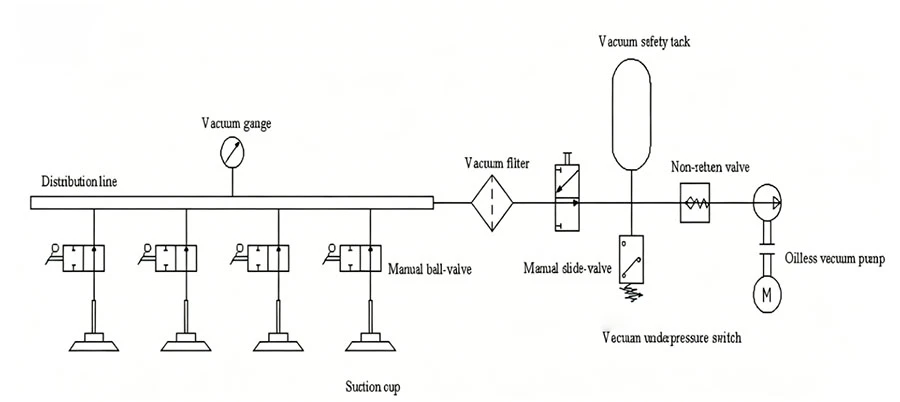
Discuss independent vacuum circuits, vacuum monitoring, reserve power where required, controlled or delayed release, load distribution, cup condition and the supporting crane or structure. The required arrangement depends on the workpiece and applicable site rules.
Can cup positions be adjusted for different sheet or panel sizes?
Yes, selected sheet and glass series use adjustable or modular layouts. The usable adjustment range, cup quantity and final working load must be confirmed for the selected configuration.
Hot Tags: industrial vacuum lifting system, China industrial vacuum lifting system manufacturers, suppliers, factory, Circular Lifting Magnets, Excavator Electromagnet, Excavator Grab Bucket, Excavator Lifting Magnet, Magnet By Types, Round Lifting Electromagnet
Previous
No InformationYou Might Also Like




Send Inquiry