


Many workshops require flexible lifting solutions. Permanent overhead cranes are not suitable for all scenarios. Portable jib cranes stand out as an economical choice.Each unit is built with a base and rotating casters, enabling easy relocation across the site. It requires no ground foundation and no adjustments to existing building structures. Quick installation means no work stoppage. You can find all essential buying information in the following content.
What Is a Portable Jib Crane?
The portable jib crane breaks through the fixed installation limitations of traditional jib cranes by integrating the cantilever slewing mechanism onto a mobile platform. Equipped with steering wheels, the wheeled base provides ample site adaptability, allowing operators to independently adjust the lifting position according to task requirements. Balancing lifting accuracy and operational flexibility, it is an efficient solution for temporary lifting scenarios in workshops, warehouses, and outdoors.
Key characteristics:
- Self-contained design - no foundation or wall mounting required
- 360° slewing rotation - full circular coverage around the mast
- Compact footprint - the fixed column occupies minimal floor space
- Integrated hoist compatibility - works with electric chain hoists, wire rope hoists, or manual hoists
Portable jib cranes cover load capacities between 0.5 ton and 2 ton. Their lifting height spans 2 meters to 8 meters, and the boom outreach measures 4 to 5 meters.These cranes follow M3 working class standards. They fit light and medium frequency lifting applications.
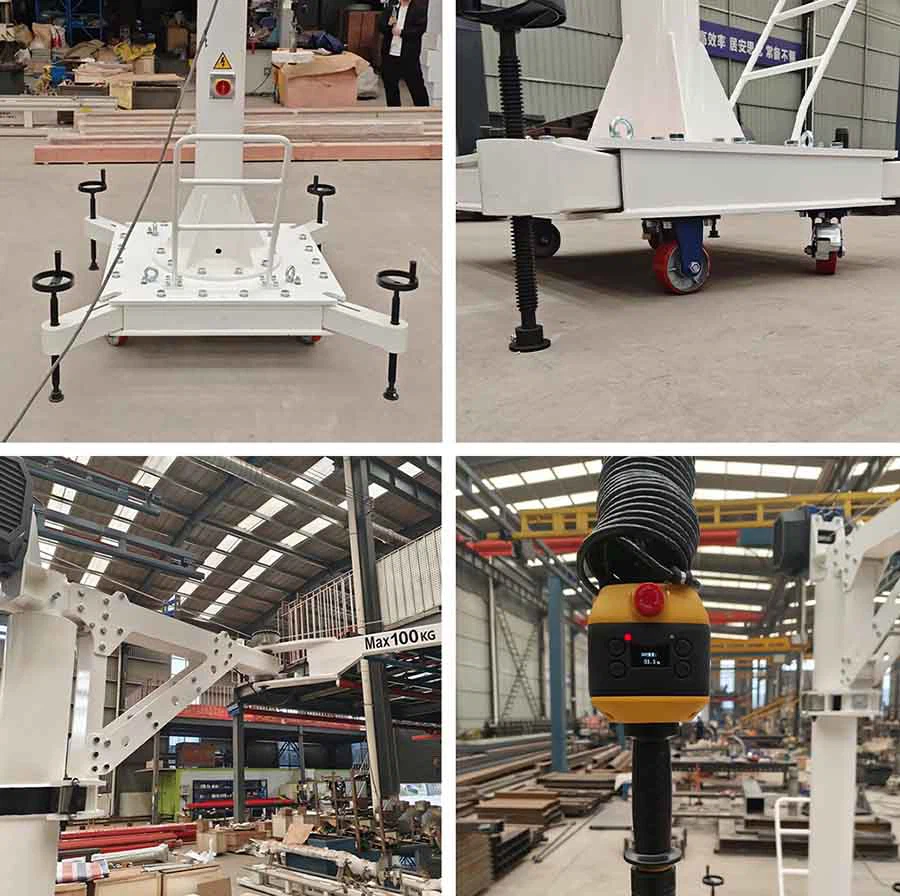
Two Main Types of Portable Jib Cranes
Not all portable jib cranes are built the same way. Understanding the structural differences helps you pick the right one for your layout.
Portable Straight Boom Jib Crane
This is the standard design - a single rigid boom extends horizontally from the top of the mast. The boom rotates 360° around the column on an anti-friction bearing.
Best for: Open floor areas where you need a clear, straight reach in all directions. Ideal for loading/unloading pallets, positioning workpieces on machines, and general workshop lifting.
Advantages:
- Simpler structure, lower cost
- Longer horizontal reach for a given capacity
- Fewer moving parts, less maintenance
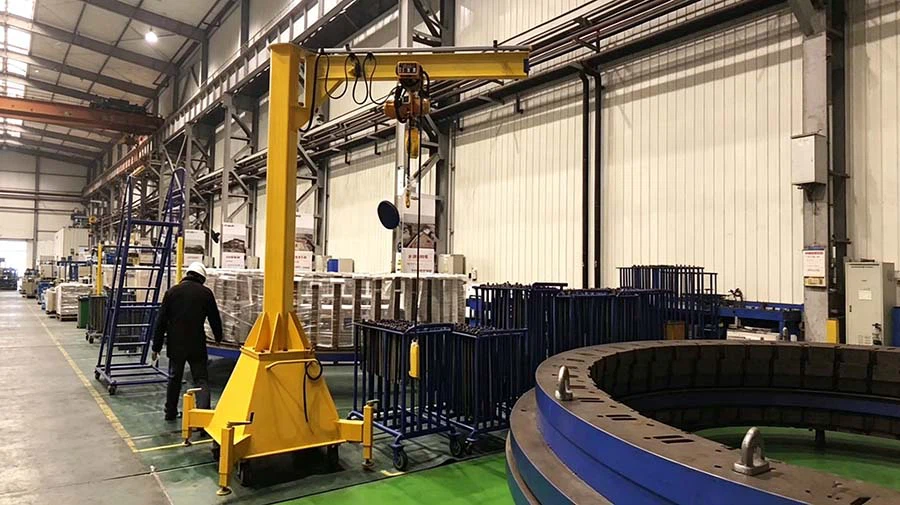
Portable Articulating Jib Crane
Articulating portable jib cranes adopt a hinged boom structure to add one more pivot. Operators can use the boom tip to bypass obstacles, reach confined corners and go under overhead fixtures. Best for: Congested workspaces with machinery, shelving, or structural columns in the way. Also ideal for loading docks where precision placement matters.
Advantages:
- Can maneuver loads around obstacles
- Greater positioning flexibility in tight spaces
- Reduced dead zone compared to a straight boom

5 Key Factors to Consider When Choosing
1. Lifting Capacity
This is the single most important specification. Portable jib cranes come in standard maximum capacities of 0.5t - 2t. Select your unit based on the heaviest recurring load on-site, rather than typical working weight. Always reserve a minimum 20% safety margin for operation.
2. Lifting Height and Reach (Boom Radius)
Lifting height determines how high you can raise a load - typically 2m to 8m for portable units. Make sure the maximum hook height clears your tallest obstruction or reaches your highest loading point.
Boom radius, or working reach, refers to the horizontal distance from the mast center to the boom end, with standard ranges of 4m to 5m. Measure your actual workspace to confirm the boom covers your full operating zone, with no need for frequent base repositioning.
3. Mobility and Base Design
Easy relocation is the main benefit, so inspect the base components fully:
- Caster type - Hard-wearing polyurethane and nylon casters work smoothly on concrete. Use lockable casters to fix the crane position when lifting.
- Tray platform size - Wider base frames improve stability, and they require more space on the workshop floor.
- Steering mechanism - Towing handles or fifth-wheel casters on select models help users steer with less effort.
- Overall weight - Manual moving is possible for units lighter than 500kg. Forklifts are required to transport heavier cranes.
4. Slewing Angle and Rotation
Most portable jib cranes offer 360° full rotation, but some economy models may be limited to 180°. Full rotation is almost always worth the extra cost - it doubles your effective work area and eliminates the need to reposition the base as frequently.
For articulating models, also check the knuckle joint rotation range - wider articulation angles give you more flexibility in confined spaces.
5. Working Environment
Plan according to your operating site:
- Indoor workshops - Regular builds serve daily work well. Temperatures from -20°C to +40°C fit most factory environments.
- Outdoor yards and loading docks - Pick units with weatherproof coating and sealed bearings. Use corrosion resistant equipment in coastal or moist locations.
- Clean rooms or food processing - Stainless steel hardware and food safe lubricants are needed here.
- Explosive atmospheres - Areas with flammable gas or dust require explosion-proof hoists and non-sparking hardware.
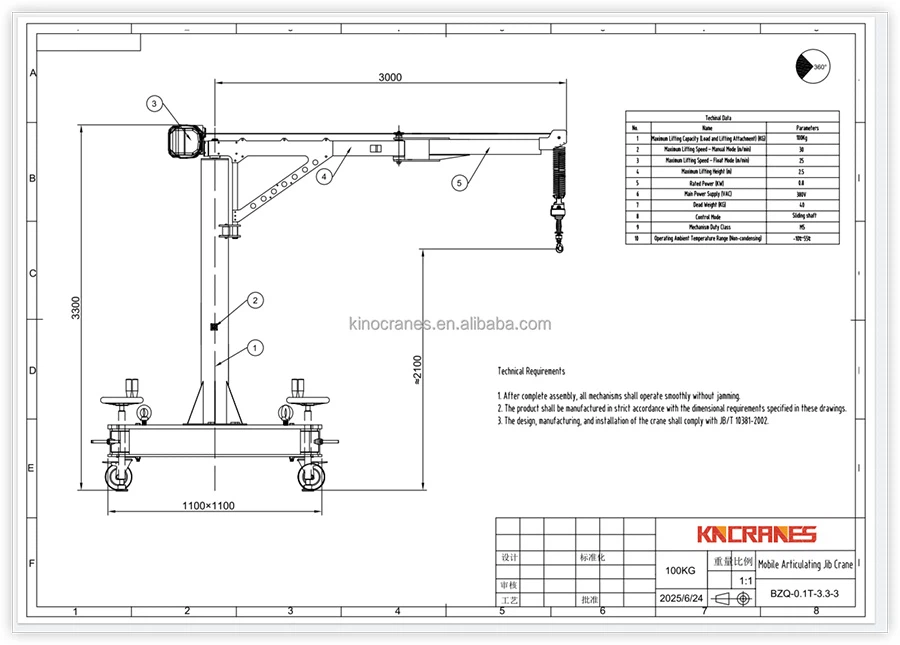
Portable Jib Crane Specifications at a Glance
| Parameter | Typical Range |
|---|---|
| Lifting Capacity | 0.5t – 2t |
| Lifting Height | 2m – 8m |
| Boom Radius (Reach) | 4m – 5m |
| Slewing Angle | 180° – 360° |
| Working Duty | M3 |
| Working Temperature | -20°C to +40°C |
| Hoist Options | Electric chain, wire rope, or manual |
| Control Method | Pendant / Remote control |
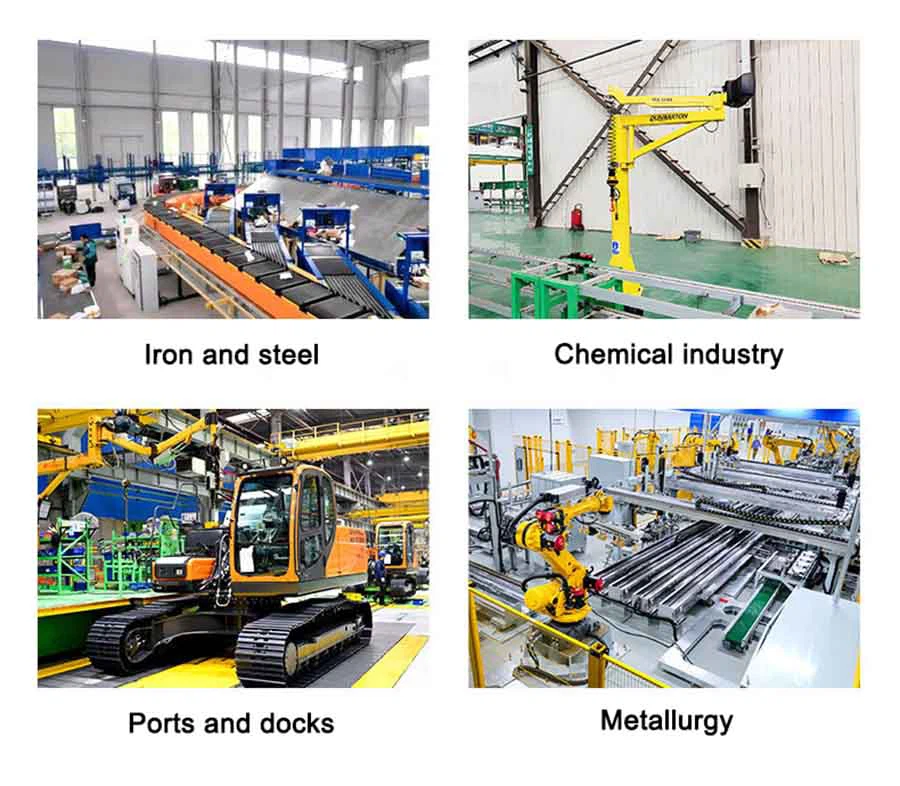
Common Applications
Portable jib cranes see extensive use in many industrial fields:
- Manufacturing workshops - place heavy parts onto CNC machines and assembly lines
- Warehouses and logistics - load and unload trucks, shift pallets where overhead cranes are not available
- Maintenance and repair - raise engines, gearboxes and other heavy pieces during equipment upkeep
- Outdoor freight yards - handle temporary lifting jobs at construction sites and shipping docks
- Petrochemical and power plants - portable maintenance lifting where permanent cranes cannot reach
- Food and paper industries - material handling in facilities with strict hygiene requirements
Portable Jib Crane vs Fixed Jib Crane
| Feature | Portable Jib Crane | Fixed Pillar Jib Crane |
|---|---|---|
| Foundation Required | No | Yes (concrete base) |
| Mobility | Freely movable | Stationary |
| Capacity Range | 0.5t – 2t | 0.25t – 10t |
| Installation | Ready to use | Requires anchoring |
| Best For | Multi-location tasks | Dedicated workstation |
| Cost | Lower (no civil work) | Higher (foundation + labor) |
If your lifting needs are under 2 tons and you need to move the crane between locations, a portable jib crane is almost always the better choice.
Why Choose Kinocranes?
Kinocranes has focused on lifting equipment production since 2008, accumulating over 15 years of rich experience in crane engineering and manufacturing.
- Manufacturing base spans 280+ acres, equipped with 8 production lines
- The company employs 1200+ people, among whom 180+ are engineers and technical personnel
- We have completed 2000+ projects serving diverse industries worldwide
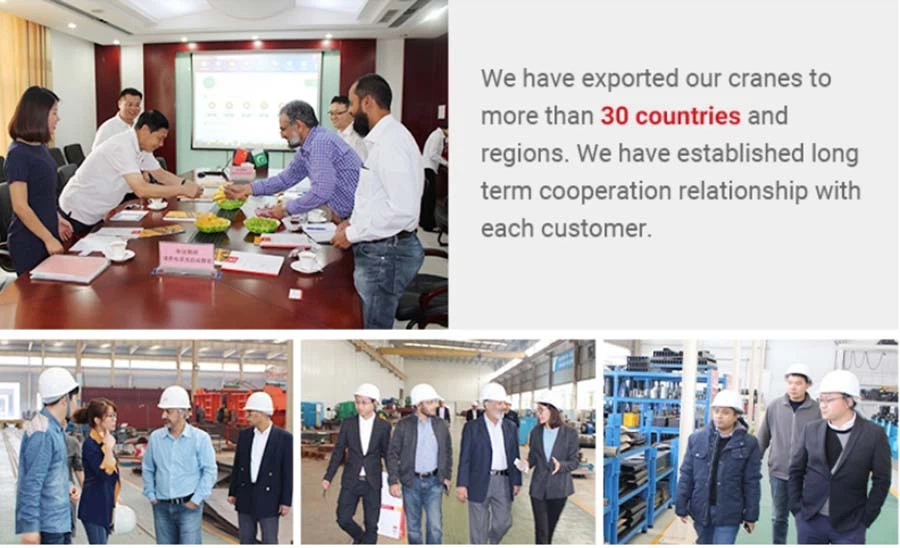
- Our products are exported to over 50 countries
- All items comply with CE and ISO standards.
- Core components are supplied by trusted brands including ABB, SEW, Siemens and SKF
- OEM and ODM orders are welcome. We develop custom solutions based on your actual needs
Full service chain available: product development, manufacturing, installation and after-sales care From standard portable jib cranes to customized articulating types with dedicated casters and hoist assemblies, we can supply suitable products for you.
Conclusion
Before you select a portable jib crane model, confirm these operating details first: rated load, lifting height, effective boom length, moving frequency and installation location (indoor or outdoor). These details decide which unit fits best. Unsuitable selection will slow down work and bring potential safety risks.
If you need technical help, send your site parameters to the Kinocranes technical team. We will give professional selection suggestions and offer a formal quote.


