

Choosing a jib crane with improper specifications will lead to poor working efficiency, extra investment costs and potential safety hazards. An undersized crane cannot handle required loads; an oversized one increases costs without proportional benefit.
This guide outlines the technical criteria for determining the appropriate portable jib crane size, using specification data from Kino Cranes' product line and engineering practices developed over 15+ years of crane manufacturing.This sizing guide works for portable jib cranes and fixed mounted jib cranes.
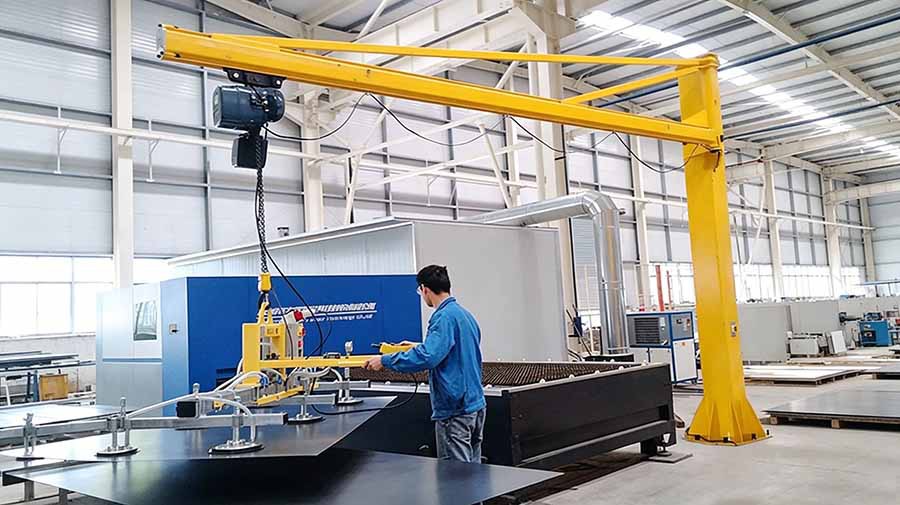
Three Core Parameters
Every jib crane selection begins with three fundamental measurements:
- Maximum load weight - the heaviest item to be lifted, including all rigging accessories, slings, and hook blocks.
- Working radius - the horizontal distance from the crane's pivot point to the furthest load placement point.
- Lifting height - the vertical distance from floor level to the highest point the hook must reach.
These three parameters define the crane's operating envelope. Each is examined in detail below.

Determining Lifting Capacity
Lifting capacity stands as the core parameter when choosing jib cranes. Picking an unsuitable capacity grade will bring hidden safety risks and hinder daily working efficiency.
Calculating Actual Maximum Load
The crane's rated load shall surpass the overall weight being hoisted, together with all accessories mounted under the hook:
Rated Capacity ≥ Maximum Load Weight + Sling Weight + Hook Block Weight + Safety Margin
Local industrial norms suggest reserving an extra 25% safety allowance based on the figured maximum load. Taking practical use as an example, when the full weight of cargo and lifting accessories reaches 2,000 kg, the crane needs a minimum rated capacity of 2,500 kg.
Standard Capacity Ranges
Kino Cranes' product line classifies portable jib cranes into the following duty tiers:
| Duty Class | Capacity Range | Typical Applications |
|---|---|---|
| Light Duty | 250 kg – 1,000 kg | Tool handling, small-parts assembly, maintenance workshops |
| Medium Duty | 1,000 kg – 3,200 kg | Manufacturing lines, warehouse loading, equipment installation |
| Heavy Duty | 3,200 kg – 5,000 kg | Steel fabrication, heavy machinery assembly, foundries |
| Extra Heavy Duty | 5,000 kg – 10,000 kg | Metallurgy, port operations, large-scale industrial processes |
Kino Cranes supplies pillar-mounted jib cranes. Its load capacity falls between 0.25 ton and 10 ton, while lifting height varies 3 m to 15 m.Wall-mounted jib cranes have capacity ranging 0.25 ton to 5 ton, perfectly fitting daily workshop and warehouse working needs.
Duty Cycle Considerations
Working usage frequency greatly influences the service lifespan of jib cranes.Units operating near their load limit for 20 lifting cycles each hour endure much heavier mechanical strain, unlike those used merely twice per day.For sites that require frequent non-stop lifting tasks, opt for a crane with one higher capacity level than actual needed load. This helps reduce component abrasion and extend the equipment service life.
Determining Working Radius (Boom Length)
The boom length defines the crane's horizontal reach. It determines the working area - the semicircular or full-circular zone within which loads can be picked and placed.
Measuring Required Reach
From the planned installation point, measure the horizontal distance to the furthest point where a load must be delivered. This measurement represents the minimum required working radius.
Kino Cranes offers the following radius configurations:
- Pillar jib cranes: 3 m to 10 m radius
- Wall-mounted jib cranes: 2 m to 6 m radius
The Radius–Capacity Relationship
A critical engineering consideration: rated capacity decreases as working radius increases. A crane rated at 5 t at 4 m radius may be limited to 3 t at 8 m radius. Selection decisions should be based on the manufacturer's load chart at the specific required radius, not the headline capacity figure alone.
Rotation Range
- Pillar-mounted jib cranes feature 360-degree rotating capability, perfectly adapting to spacious working areas that demand flexible multi-angle material handling.
- Wall-mounted jib cranes adopt 180-degree rotation design, fitting daily lifting tasks beside walls and vertical columns without the need for full circular turning.
For lifting work limited to single side wall zones, wall-mounted jib cranes can effectively optimize ground space utilization and cut down overall project expenditure.
Determining Lifting Height
Lifting height - referred to technically as height under boom (HUB) - is the vertical clearance from the floor to the underside of the boom at its highest position.
Height Calculation Procedure
1.Check the maximum height of barriers including storage racks, production machines and door frames that goods need to pass over.
2.Take the actual height of transported goods into account.
3.Include vertical dimension of sling and hook parts.
4.Reserve no less than 300 millimetres safety gap to ensure steady cargo handling.
Practical calculation reference: maximum barrier height 4.5 m, cargo height 1.2 m, sling and hook height 0.5 m
Minimum HUB = 4.5 + 1.2 + 0.5 + 0.3 = 6.5 m
Kino Cranes jib cranes cover lifting height ranging from 3 m up to 15 m. The product lineup suits installation demands for workshops with low ceiling as well as large industrial buildings with high vertical space.
Selecting the Mounting Configuration
The mounting type directly affects crane dimensions, installation requirements, and operational flexibility.
Floor-Mounted (Pillar) Jib Crane
- Optimal application: Wide open work zones, fixed working stations and outdoor storage yards
- Installation requirement: Firm reinforced concrete foundation or custom fabricated base plate
- Operational advantage: Full 360-degree rotating coverage, broad load capacity selection, optional movable structural designs
- Space consideration: Certain ground space needs to be reserved for the bottom base assembly
Wall-Mounted Jib Crane
- Optimal application: Mounting positions along building walls and load-bearing structural columns
- Installation requirement: Solid wall or strengthened column capable of bearing total weight of crane body and peak working load
- Operational advantage: Takes no ground space, economical installation cost and quick on-site setup
- Space consideration: Rotation scope limited within 180 degrees, maximum applicable load reaches 5 t
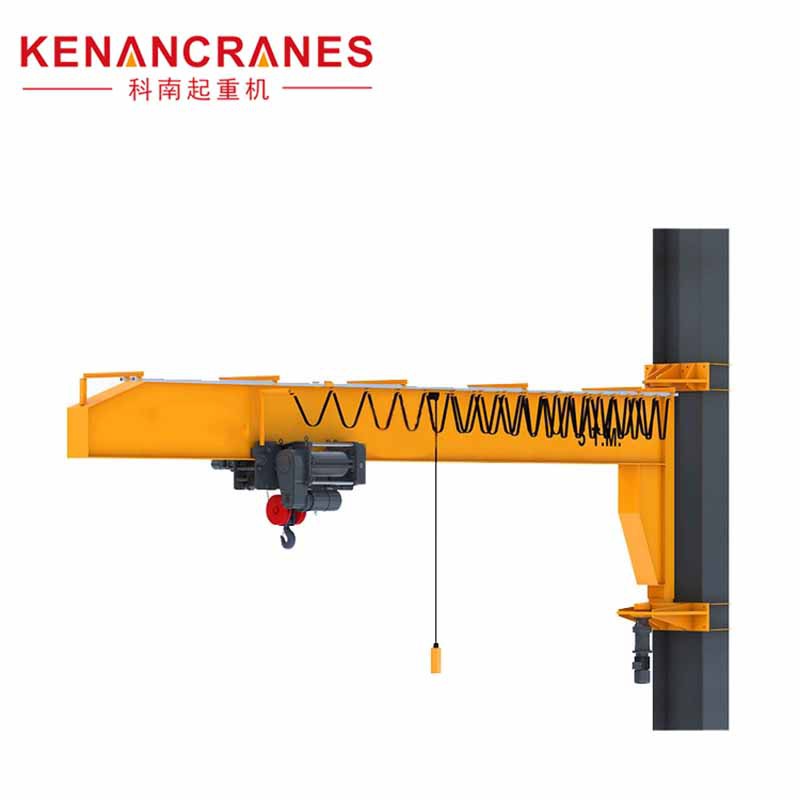
Kino Cranes provides multiple fixing options for both wall and floor mounting with a selection of hoisting equipment - electric wire rope hoists, chain hoists, and manual hoists - matched to each crane configuration.If you need mobility without foundation, choose a portable jib crane with similar capacity, radius, and lifting height calculations.

Worked Sizing Example
A metal processing factory located in Singapore needs jib crane equipment to carry stamped metal workpieces.
| Parameter | Value |
|---|---|
| Heaviest component + rigging | 1,800 kg |
| Required capacity (with 25% margin) | 2,250 kg → 2.5 t selected |
| Furthest reach from column | 5.5 m → 6 m radius selected |
| Required lifting height | 5.8 m → 6 m lift height selected |
| Installation location | Along workshop wall |
| Required coverage | 180° sufficient |
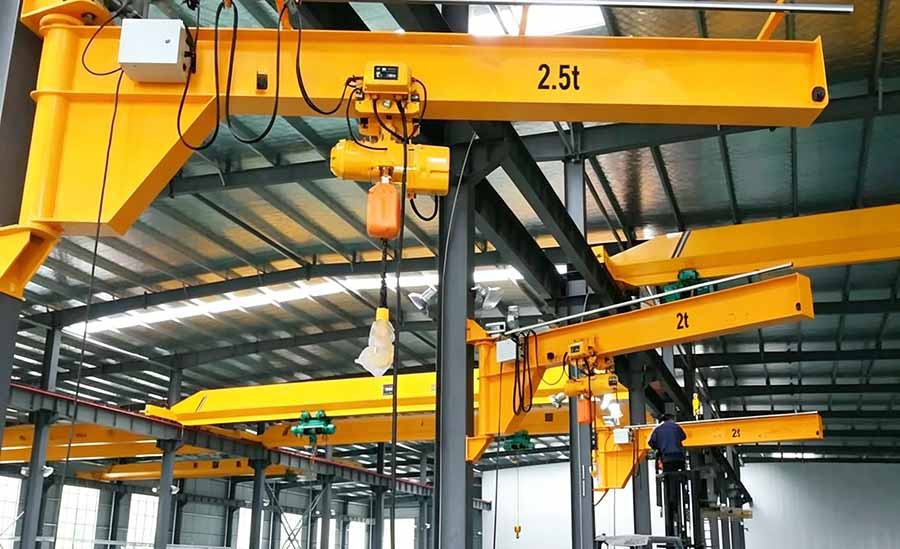
We match suitable wall-mounted jib crane from Kino Cranes for this working scenario. The unit comes with 2.5 t rated capacity, 6 m working radius and 6 m lifting height, fitted with electric chain hoist and pendant control system.For a fully mobile solution, you may also consider our portable jib crane range.
Common Specification Errors
- Excluding future capacity requirements. Sizing a crane for anticipated operational growth is significantly more cost-effective than replacing an undersized unit within two years.
- Relying on headline capacity without consulting load charts. Rated capacity varies with radius; selection must be verified against the manufacturer's load chart at the required working radius.
- Underestimating foundation requirements. Floor-mounted cranes require engineered foundations designed for the combined static and dynamic loads.
- Neglecting headroom constraints. Low-ceiling installations may require low-headroom hoist configurations, which affect the crane's overall dimensional envelope.
- Many buyers focus merely on upfront purchase cost while ignoring long-term operational expenses. Budget-priced cranes failing to fit actual working conditions will bring extra spending on downtime recovery, routine maintenance and safety improvement work.
About Kino Cranes
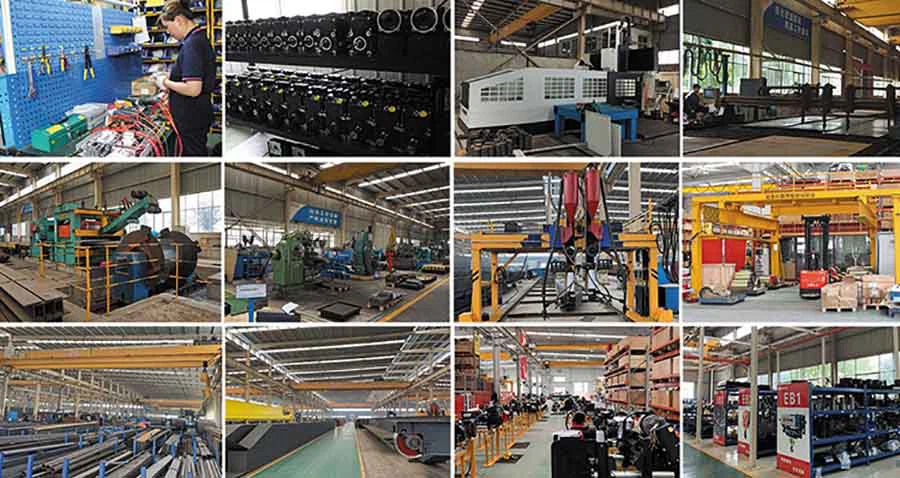
Since its establishment in 2008, Kino Cranes engages in crane development, manufacturing, overseas sales, field installation and follow-up after-sales services.
- 1,200+ employees, including 180+ professional engineers and technical specialists
- 280-acre manufacturing plant fitted with over 210 production and precision testing devices
- 2,000+ successful project deliveries for various industrial sectors across more than 50 countries
- All products comply with CE and ISO standards, adopting core components from trusted global brands such as ABB, SEW, Siemens and SKF
- Flexible custom engineering available - motors, reducers and bearings can be tailored to match unique client requirements
- Professional overseas teams provide local on-site assembly, equipment commissioning and operational training
Catering to local demand, Kino Cranes serves Singapore and the wider Southeast Asian region through Kino Cranes Pte. Ltd., delivering responsive regional technical support backed by our complete manufacturing resources.
Pre-Quotation Sizing Checklist
Before requesting a formal quotation, the following data should be prepared:
- Maximum load weight (including all rigging and below-the-hook devices)
- Required working radius
- Required lifting height under boom
- Available floor and wall space at installation point
- Preferred mounting configuration (floor-mounted or wall-mounted)
- Duty cycle classification (lifts per hour, operational hours per day)
- Operating environment conditions (indoor/outdoor, ambient temperature range)
- Available power supply specifications
- Projected capacity expansion requirements
-
Is the crane required to be portable or fixed
Technical Consultation
For applications requiring detailed engineering analysis, Kino Cranes provides site assessment and specification review services. The engineering team evaluates operational parameters, recommends crane configurations, and delivers detailed technical quotations.


