





Wall Mounted Articulating Jib Crane
Capacity:70 – 900 kg
Boom Span:4.9 m
Primary Boom Rotation:Up to 200°
Secondary Arm Rotation:Up to 360°
Mounting:Wall / structural column
Product Description
Dual-axis precision lifting.Zero floor footprint.
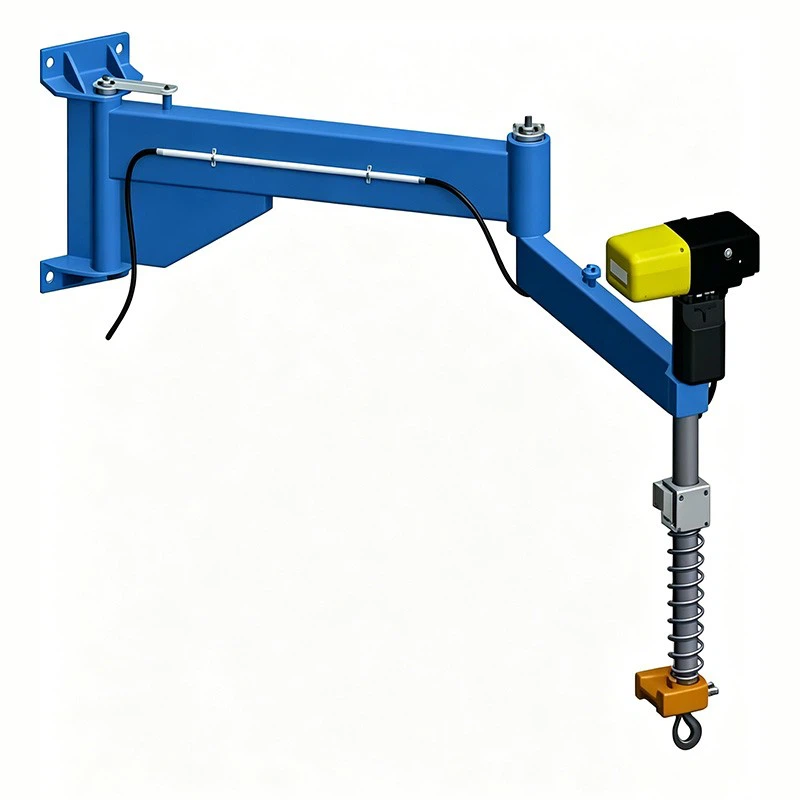
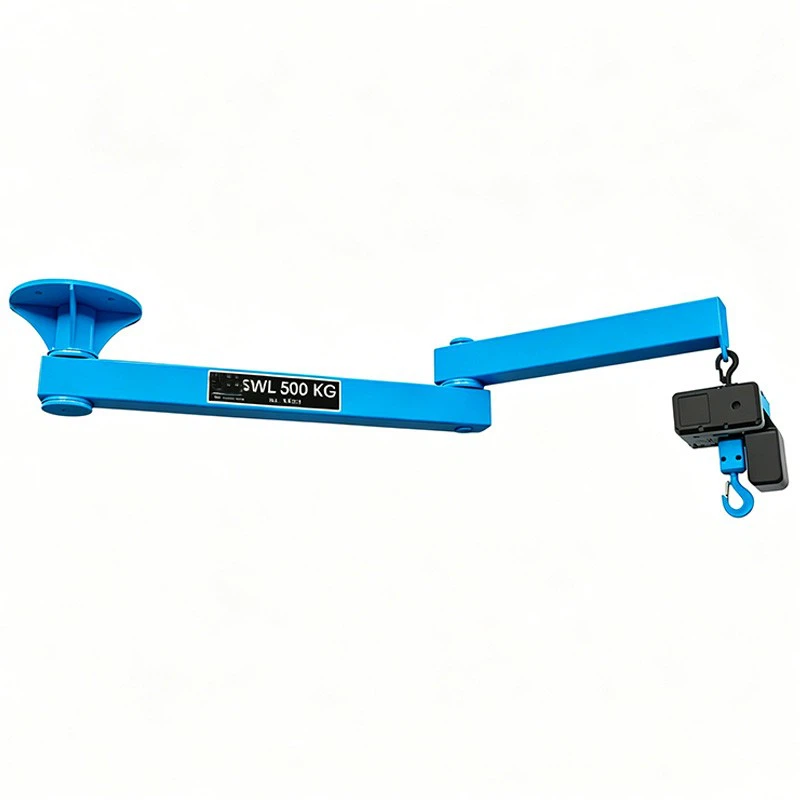
Wall mounted articulating jib cranes are fixed onto existing building walls or load‑bearing columns. The design includes two sets of pivoting structures: a main boom and an articulated auxiliary arm. This configuration supports flexible load handling in multiple directions. Standard single‑boom jib cranes cannot provide this level of movement.
With this crane type, operators can lift loads around corners, pass through door openings, move beneath obstacles, and place materials with high precision.
Specifications
| Parameter | Range |
|---|---|
| Capacity | 70 – 900 kg |
| Boom Span | 4.9 m |
| Primary Boom Rotation | Up to 200° |
| Secondary Arm Rotation | Up to 360° |
| Mounting | Wall / structural column |
| Construction | Steel, enclosed track or structural profile |
How It Works
The crane has two rotation axes instead of one.
- Primary boom - swivels from the wall-mounted pivot. Covers up to 200° of arc.
- Secondary arm - pivots at the end of the primary boom. Rotates a full 360°.
This means an operator can swing a load into position without needing clearance for the entire boom length. In tight work cells, this makes the difference between a crane that fits and one that doesn't.
Advantages
- Navigates obstacles:Lift around columns, conveyors, ductwork, and fixed equipment without modifying the building.
- Zero floor footprint:All loads transfer into the wall structure. No base plate, no foundation, no lost floor space.
- Precise load placement:Two independent axes give operators fine control for loading machines, fixtures, and adjacent workstations.
- Extended reach:The secondary arm reaches past obstacles and into adjacent bays that a straight boom cannot access.
- Low effort operation:Consistent rotational responsiveness reduces push-pull force and operator fatigue.
- Works in existing facilities:No need to remove columns or restructure the building. The crane adapts to the space you have.
Applications
Assembly lines - positioning components at individual workstations with limited space
Machine loading - reaching into CNC machines, lathes, and presses through offset doorways
Maintenance workshops - lifting replacement parts around dense equipment layouts
Paint booths and finishing - maneuvering workpieces in enclosed spaces with no floor obstructions
Loading docks - transferring materials between receiving bays and adjacent storage zones
Warehouse staging - spot-loading in confined areas separated by racking or walls

Configuration Options
| Option | Description |
|---|---|
| Electrification | Power to hoists or tools through collector ring assemblies on both axes |
| Pneumatic supply | Internal compressed air piping for air balancers and vacuum lifters |
| Rotation stops | Adjustable mechanical stops to limit swing arc and prevent collisions |
| Vacuum lifter mount | Engineered provisions for vacuum pad systems (sheet metal, glass, flat stock) |
| Hoist compatibility | Electric chain hoist, wire rope hoist, air balancer, or manual lever hoist |
Installation Requirements
Before ordering, confirm these four items:
1.Structural capacity - The wall or column must support the crane's dead weight plus the rated live load. Engineering verification is recommended.
2.Mounting height - The bracket must be installed high enough to provide adequate hook height while maintaining clearance for the full rotation arc.
3.Mounting surface - Reinforced concrete or structural steel is typical. Light partition walls are not suitable.
4.Overhead clearance - The articulating design requires less overhead envelope than a traditional cantilever boom, but a minimum clearance above the boom arc is still necessary.
Standards and Certification
Designed and manufactured to applicable industrial standards. Each unit is load tested before shipment. CE and ISO certifications available on request.
Capacity ratings apply at the tip of the secondary arm. Overload protection and operator training are recommended as part of a safe lifting program.

Why KINO CRANES
- 15+ years of crane manufacturing experience
- 30+ engineers on the technical team
- 8 production lines across a 280-acre facility
- 2,000+ cases across various industries
- Components from ABB, SEW, Siemens, SKF, FAG, and other recognized brands
- OEM/ODM accepted; non-standard customization available
- On-site installation, commissioning, and operator training
- Spare parts and maintenance support in 50+ countries
Reach out to us for quotes and technical consulting. Our engineers will review your site conditions, and prepare a full proposal within 48 hours.

FAQ
Q:What is the difference between a wall mounted articulating jib crane and a standard wall mounted jib crane?
A:Standard wall mounted jib cranes feature one fixed boom and a single pivot. Articulating models add an extra pivot and a jointed arm at the end of the main boom. This extra moving section lets users rotate loads freely. It also makes it easier to work around obstacles, and place materials in areas unreachable by regular straight booms.
Q:What is the maximum capacity of a wall mounted articulating jib crane?
A:Standard models range from 70 kg to 900 kg. Higher capacities may be available through custom engineering - contact our team with your specific requirements.
Q:Can it be installed on any wall?
A:No. The mounting surface must be structurally adequate to support the combined dead weight and live load. Reinforced concrete walls, structural steel columns, and purpose-built mounting structures are typical. A structural evaluation of the mounting point is recommended before installation.
Q:Does it require a foundation?
A:No. The crane mounts directly to the wall or column and transfers all loads into the building structure. No floor foundation or base plate is needed.
Q:How much rotation does the crane provide?
A:The primary boom rotates up to 200 degrees. The secondary articulated arm rotates a full 360 degrees. Both axes operate independently, giving the operator full control over the load path.
Q:What span lengths are available?
A:Standard spans range up to 16 feet (approximately 4.9 meters). Custom spans are available for specific facility requirements.
Q:Can I use my existing hoist with this crane?
A:In most cases, yes. The crane is compatible with electric chain hoists, wire rope hoists, air balancers, vacuum lifters, and manual lever hoists. Confirm compatibility with our engineering team when placing your order.
Q:How long does installation take?
A:Installation time depends on site conditions and crane configuration. A typical wall mounted articulating jib crane can be installed and commissioned in 1–2 days once the mounting point is prepared.
Q:Do you provide on-site installation?
A:Yes. KINO CRANES provides on-site installation, commissioning, operator training, and after-sales maintenance support globally.
Q:What certifications are available?
A:CE and ISO certifications are available. All cranes are load tested before shipment and accompanied by full technical documentation.
Hot Tags: wall mounted articulating jib crane, China wall mounted articulating jib crane manufacturers, suppliers, factory, 1 Ton Electric Hoist, Column Mounted Jib Crane, Jib Crane By Types, Pillar Mounted Jib Crane, Wall Bracket Jib Crane, Wall Mounted Jib Crane
Previous
Wall Mount Jib CraneYou Might Also Like


Send Inquiry