

If you have ever seen the handling of a 20 ton steel plate or a 5-ton steel coil, then you will inevitably see the overhead crane running. But not all overhead cranes are the same. Their designs are divided into three basic types - each type has different load weights, spatial constraints, etc. Understanding these categories will help you choose the crane that matches your factory correctly.
Here's a breakdown of the three core types, with real-world applications and how brands like Kinocranes tailor them to outlast brutal environments:
1. Single Girder Overhead Cranes: The Space-Saving Workhorse
Design: A single horizontal beam (girder) supported by end trucks that move along elevated runways. The hoist and trolley run along the bottom flange of the girder .
Capacity: A single beam can withstand a maximum load of 20 tons, with a few models reaching up to 32 tons (customized according to specific working conditions).
Suitable environments for use: workshops, warehouses, and production lines, low clearance, low budget, or light to medium lifting operations.
Kinocranes' Practical Twist:
While standard single girders excel in general manufacturing, Kinocranes reinforces key stress points for abrasive environments. For example:
Sealed Hoists: In grain silos where dust kills motors, they use IP65-rated hoists to prevent silica ingress.
Low-Headroom Designs: For warehouses with ceiling height limits, their compact trolley design maximizes lift height without compromising stability .
Single girders dominate markets in Asia-Pacific due to rapid warehouse expansion . They're 20–30% cheaper than double girders but sacrifice heavy-duty endurance .

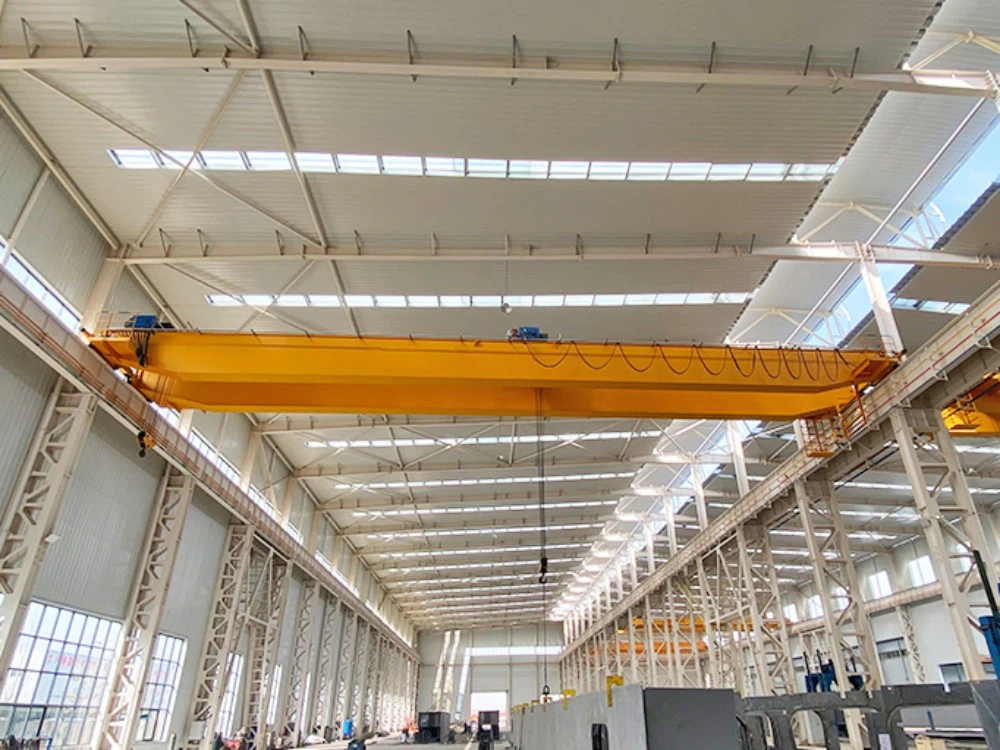
Double Girder Overhead Cranes: The Heavy-Lift Titans
Design: Two parallel girders supported by end trucks, providing superior load distribution and higher hook heights. The hoist travels on a rail between the girders .
Capacity: Standard ranges from 5 to 50+ tons, with some models handling 500 tons in steel mills .
Best For: Automotive, aerospace, and metallurgy where heavy loads, high lifts, or frequent use are non-negotiable.
Kinocranes' Engineering Edge:
In a Chilean copper mine, double girders face corrosive humidity and constant use. Kinocranes' solution included:
Bogie End Trucks: Distributing load across multiple wheels to reduce rail wear and prevent derailment.
Dual Brakes & Redundant Hoists: Critical for molten metal handling in steel plants, where failure isn't an option .
Double girders hold over 50% market share in heavy industries due to their durability . Their design allows for auxiliary hoists or specialized attachments like magnets or grabs .
3. Underhung Cranes: The Layout-Flexibility Specialists
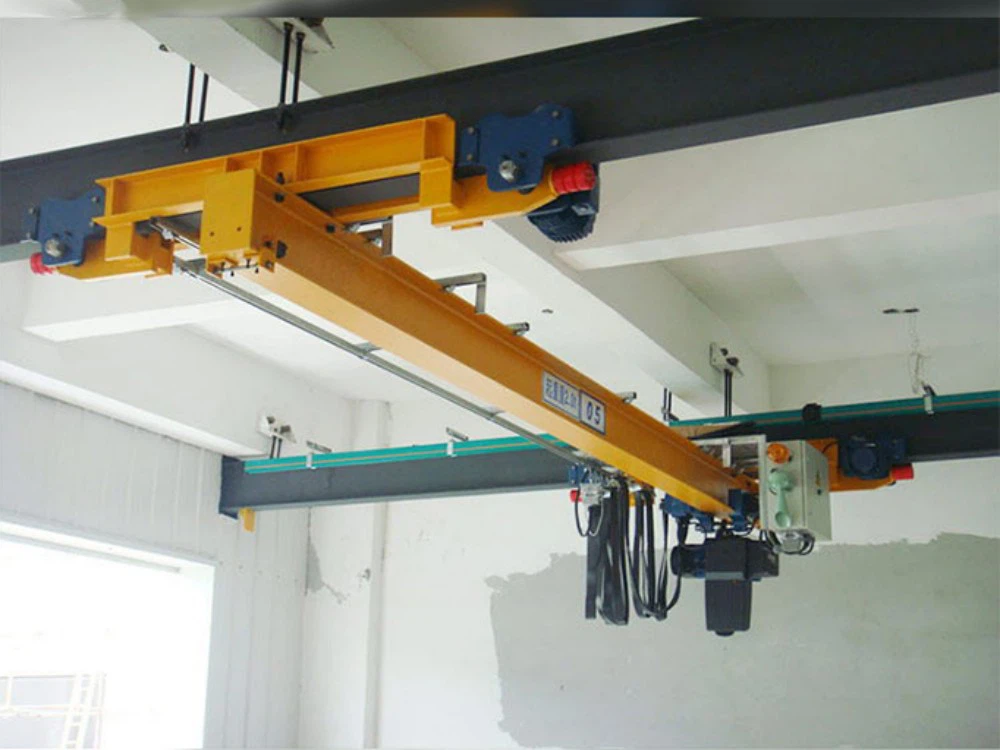
Design: The crane's end trucks hang from overhead runways mounted to the building structure (not supported by freestanding columns). The hoist runs along a track under the girder .
Capacity: Usually lighter loads (1–10 tons), ideal for assembly lines or areas where floor space is sacred.
Best For: Manufacturing cells, production lines, and facilities needing multi-directional movement without floor obstructions.
Kinocranes' Adaptation:
In e-commerce logistics centers, underhung cranes move goods between packing stations. Kinocranes integrates:
Modular Runways: Allowing easy reconfiguration when production lines shift.
RFID Collision Avoidance: Sensors prevent cranes on intersecting runways from clashing .
Why It Matters:
Underhung systems use existing building support structures, avoiding costly floor columns. They're the top choice for retrofitting older facilities.
How to Choose: It's About Physics, Not Features
Selecting a crane isn't about catalog specs-it's about solving material flow puzzles. Ask:
1.Load Profile: Is it uniform steel coils or irregular scrap metal? (Double girders handle asymmetry better.)
2.Environment: Dusty? Corrosive? Humid? (Sealed components or corrosion-resistant coatings matter.)
3.Flow Path: Straight-line transfers vs. multi-directional moves? (Underhung excels in complex paths.)
The Bottom Line
Overhead cranes are the backbone of industrial material handling. The three primary types-single girder, double girder, and underhung-each serve distinct roles:
Single Girder Overhead Crane: Cost-effective for light/medium loads in space-limited sites.
Double Girder Overhead Crane: Heavy-duty muscle for extreme capacities and 24/7 operations.
Underhung Overhead Crane: Layout flexibility for dynamic production environments.


